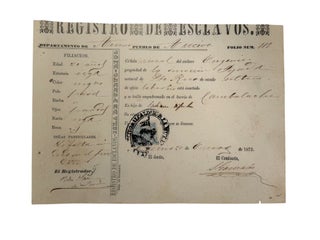
Puerto Rico Slave Registration After the Moret Law, Listing a 44-Year-Old Enslaved Man Named “Epifanio” Who Remained in Bondage, 1873
Manuscript & Autographs
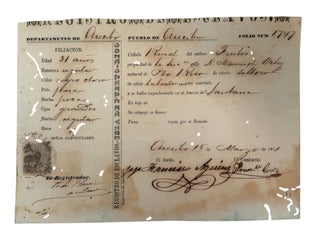
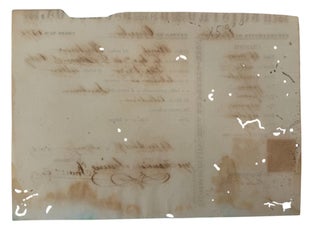
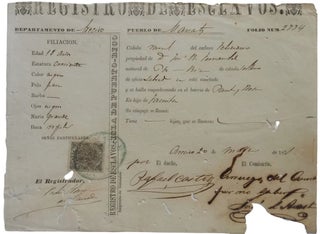
Puerto Rican slave registration document from January 1873, recording the legal identity, ownership, agricultural occupation, parentage, and physical classification of Epifanio, a forty four year old enslaved Black man in Arecibo less than three months before slavery was abolished in Puerto Rico. Issued after Spain's 1870 Moret Law had initiated a limited process of emancipation but before the abolition law of March 22, 1873, the cédula placed Epifanio within a registration system designed to record enslaved people by name, family relations, occupation, owner, residence, civil status, and identifying physical characteristics. The January 20 date makes the document especially closely situated to abolition, recording Epifanio as legally enslaved only weeks before the Spanish National Assembly dismantled the legal institution under which the certificate had been issued.Registro de Esclavos, Isla de Puerto Rico. Arecibo, Puerto Rico, January 20, 1873. Single printed and manuscript cédula, folio no. 7215. The document identifies “Epifanio” as an enslaved man, “propiedad de la Sucn. Tafarella,” forty four years old, a native of Puerto Rico, single, and “de oficio labrador.” He is recorded as “no está coartado” and as registered in the barrio of Cambalache, with his mother identified as “Petrona.” The printed “Filiacion” column subjects his body to a standardized identifying description: regular stature, “Color negro,” sparse hair, sparse beard, brown eyes, and a regular nose. Under “Señas particulares,” the manuscript records “Cojo de la pierna izquierda,” identifying him as lame in the left leg and incorporating a physical disability into the identifying data maintained by the slave registry. The lower portion differs from the earlier 1871 forms in carrying a prominent signature beneath “El Registrador,” while extensive insect damage has removed portions of the printed heading and margins. The verso bears manuscript offsetting and additional evidence of administrative handling.
Epifanio's cédula was produced at the endpoint of Puerto Rico's rapidly changing legal regime. The Moret Law of 1870 had granted freedom to specified categories of enslaved people, including those aged sixty and older, those belonging to the state, and children born after September 17, 1868, while leaving a forty four year old man such as Epifanio legally enslaved. His notation as “no está coartado” further records that he had not entered coartación, the mechanism through which an enslaved person could make payments toward self purchase. His recorded occupation as “labrador” placed him within Puerto Rico's agricultural labor economy, while “Cojo de la pierna izquierda” shows how the registry extended beyond racial and occupational classification to bodily characteristics capable of distinguishing one enslaved person from another. On March 22, 1873, only about two months after this cédula was dated, the Spanish National Assembly abolished slavery in Puerto Rico, compensating former enslavers while requiring the emancipated population to enter labor contracts for an additional three years. Extensive insect damage with numerous wormholes and substantial losses along the upper and side margins, affecting portions of the printed heading and several fields; moderate toning and staining, with principal manuscript entries and the registrar's signature remaining legible. Overall fair condition. An individually named record of the administrative system that converted Epifanio's race, body, physical disability, agricultural labor, parentage, residence, and legal ownership into the identifying data of slavery during the final months before abolition in Puerto Rico.
Item #23800
Price: $850.00
See all items in Puerto Rico, Other (Chicano/Latino), Imperialism & Colonialism
See all items in American History by State, Chicano & Latin American History, International & Global Culture
See all items by Slavery Puerto Rico
See all items in Puerto Rico
Suggested Other (Chicano/Latino)Browse All






Suggested Puerto RicoBrowse All


Suggested American History by StateBrowse All