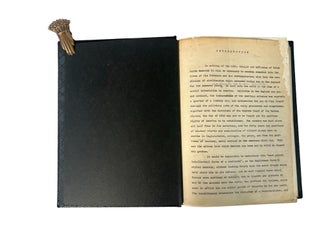
"Black Metropolis: A Study of Negro Life in a Northern City" Sociological Study of Black Communities in Chicago After the Great Migration, First Edition 1945
First Edition
Drake, St. Clair, and Horace R. Cayton. Black Metropolis: A Study of Negro Life in a Northern City, documenting African American migration, labor, housing, class, and culture in Chicago’s Bronzeville. Developed from the Cayton Warner Research Project and related field investigations, the book examined Bronzeville as a complete urban society whose institutions had been formed under the combined pressures of migration, industrial employment, residential segregation, and exclusion from much of the city’s economic life. Introduction by Richard Wright connecting the authors’ style of Black literary modernism in Native Son and Black Boy to housing, work, poverty, and race in Chicago.Drake, St. Clair, and Horace R. Cayton. Black Metropolis: A Study of Negro Life in a Northern City. New York: Harcourt, Brace and Company, 1945. First edition. 809 pages. Publisher’s rust cloth with printed spine label, 6 x 8.75 inches. The four parts trace the “Flight to Freedom,” the Great Migration, the 1919 Chicago race riot and its aftermath, the color line, employment discrimination, Black union participation, political organization, religious life, business ownership, class structure, family life, and efforts toward “Advancing the Race.” Thirty three tables and thirty nine maps, charts, and graphs present demographic, occupational, economic, religious, and neighborhood data. The authors’ acknowledgments identify interview documents, newspaper excerpts, and approximately twenty years of research conducted through projects supported by the Works Projects Administration, the Julius Rosenwald Fund, the University of Chicago, and institutions on Chicago’s South Side.
Drake and Cayton extended the methods of Robert E. Park, Robert Redfield, Louis Wirth, and the University of Chicago while revising the Chicago School’s treatment of urban communities by paying specific attention to racial segregation. Their account records how restrictive housing practices produced the expanding Black Belt, how discriminatory employment systems created a “job ceiling,” and how Black Chicagoans developed churches, newspapers, businesses, political organizations, clubs, and mutual aid structures within those limits. The book provided later historians and sociologists with a detailed account of the Great Migration’s urban consequences and of the institutional formation of modern Black Chicago. Lacking dust jacket; cloth rubbed and soiled with pronounced moisture staining to the boards, endpapers, and margins of the preliminary leaves; spine ends and corners worn. Text block sound and legible, binding tight. Overall fair to good condition. First edition of the defining sociological study of Bronzeville, linking African American migration and economics to racial segregation.
Item #23700
Price: $385.00
See all items in African American Family & Community Life, African American Labor & Employment, Civil Rights Movement, Illinois, Civil Rights Movement
See all items in African American History, American History by State, Civil Rights
See all items by St. Clair Drake Horace Cayton
See all items in Illinois
Suggested Civil Rights MovementBrowse All




Suggested IllinoisBrowse All



Suggested African American HistoryBrowse All


Suggested American History by StateBrowse All