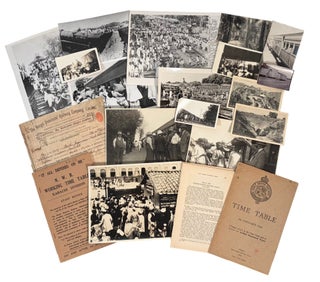
British India Railway and Military Administrative Staff Photo Archive Documenting Colonial Transportation, Military Administration, and Wartime Logistics, circa 1930s–1943
Photograph
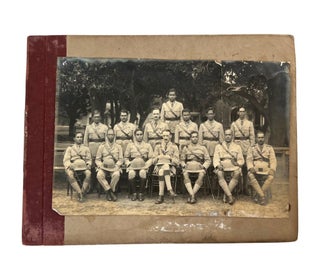
British Indian railway and military administrative staff photo archive, circa 1930s to 1943, documenting the trained Indian clerical, instructional, stores, and supervisory personnel who operated institutions central to colonial transportation and wartime logistics. The principal photograph depicts the instructional and clerical staff of the Railway Training School at Bina, the first Area School established by the Great Indian Peninsula Railway, which operated there from 1926 until its transfer to Bhusawal in 1962. The two dated portraits extend this administrative record to the Rawalpindi Arsenal in 1942–43 and the Cantonment Board at Ambala in 1941, placing railway education beside military supply and cantonment government during the Second World War.Photo archive of 3 Large silver gelatin photographs mounted on cardstock, Each Photographer boards measure 12 x 16 inches, and Photograph 8½ x 11 inches, Bina, Rawalpindi, and Ambala, India, circa early 1940s. The Bina portrait identifies approximately sixty members of the “Instructional & clerical staff, R.T.S. Bina,” posed in six rows before a tiled railway building bearing the sign “The Railway Training School.” A second photograph, captioned “Clerical staff (including Stores Branch) of Rawalpindi Arsenal,” records employees photographed at the departure of S. Avtar Singh in 1942-43; a printed roster identifies staff by row and includes many locals. The third photograph records a farewell to Lieutenant Colonel G. Leslie-Mold, president of the Cantonment Board at Ambala, on April 25, 1941, with British military officers and Indian civilian officials identified beneath the image. Leslie-Mold later served as Assistant Adjutant General and Director of Personnel Services at Army Headquarters in India.
Railway schools developed as the expanding colonial network required standardized instruction in traffic control, station procedure, accounting, freight handling, signaling, and the clerical routines through which trains, goods, and personnel were coordinated across long distances. Railways allowed the British administration to move troops rapidly, supply cantonments and arsenals, connect agricultural and mineral districts with ports, and impose common schedules and bureaucratic procedures across the colony; they also created a large Indian technical and clerical workforce whose knowledge kept the system operating. The portraits record this institutional hierarchy with European officers occupying senior positions, while Indian instructors, accountants, clerks, store employees, and subordinate officials form the numerical body of each organization. Surface wear, toning, rubbed edges, corner losses, and occasional marks to the mounts; photographs remain generally clear and well defined. Overall in good condition. A concentrated visual record of the Indian personnel who sustained railway instruction, military provisioning, and cantonment administration within the transport and defense infrastructure of late British rule.
Item #23662
Price: $550.00
See all items in Imperialism & Colonialism, India, Labor & Labor Movements, Transportation Systems
See all items in International & Global Culture, Labor, Environment & Industry
See all items by Colonial India Railway Training School
See all items in India
Suggested Transportation SystemsBrowse All


Suggested IndiaBrowse All