Republican China During the Fall of Empire, Peking and North China Large Archive of 40 Photographs, circa 1910s
Photograph
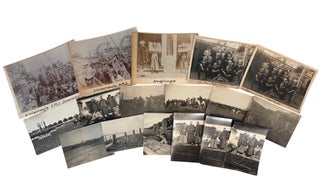
Peking and North China travel photo archive, circa 1912 to 1918, documenting the former imperial capital during the turbulent opening years of the Republic of China, when centuries of Qing imperial rule had only recently ended and Beijing remained the political and cultural heart of northern China. The photographs record a landscape where imperial monuments, Buddhist temples, ancient roads, and rural villages continued to define daily life despite the collapse of the dynasty in 1912. Produced during the era that followed the Xinhai Revolution and preceded the consolidation of the warlord period, the archive preserves a city and surrounding countryside poised between imperial tradition and an uncertain republican future.Photo archive of 40 original silver gelatin photographs, ranging from approximately 2 × 3 inches to 4 × 6 inches, Peking (Beijing) and North China, circa 1912 to 1918. The photographs depict the Temple of Heaven, the Summer Palace, Pei Hai (Beihai) Park, the Forbidden City and its surrounding walls, the White Dagoba at Miaoying Temple, monumental ceremonial gateways, pagodas, temple courtyards, the Great Wall north of Peking, the Western Hills, stone bridges, lakes, canals, and mountain landscapes. Other photographs show Buddhist monks walking through temple precincts, camel caravans crossing rocky valleys, mule carts on country roads, grazing livestock, village architecture, and rural agricultural scenes beyond the capital. Contemporary manuscript captions identify numerous locations, including "The Great Wall of China," "Temple of Heaven, Peking," "Pei Hai Grounds, Peking," "Bridge over stream between Jade Fountain & Summer Palace," "The 3rd Green Golf at Paomachang, Peking," "Western Hills near Peking," "Camel Drive at the Great Wall (Nankow Pass) north of Peking," and "Temple in the Western Hills near Peking (Golden Roof)." One inscription notes that several views "were taken by the younger Miss Dunne last summer," preserving a small but meaningful record of the archive's contemporary provenance.
This photo archive belong to one of the most consequential transitions in modern Chinese history. The Qing dynasty collapsed in 1912 after more than two and a half centuries of rule, ending the imperial system that had governed China since 221 BCE. Although the Republic of China replaced the monarchy, Beijing remained filled with imperial architecture, ceremonial spaces, and religious institutions whose daily rhythms changed only gradually. The Forbidden City was still occupied by the abdicated emperor Puyi until 1924, Buddhist monasteries continued to function throughout the Western Hills, and camel caravans remained an essential means of transporting goods across northern China's mountain passes. Foreign travelers could still move through monuments that only a generation earlier had been closely associated with imperial authority, while political power increasingly shifted among competing republican governments and regional military leaders during the emerging Warlord Era. Rather than emphasizing political upheaval directly, the archive records the remarkable continuity of Beijing's monumental landscape and traditional patterns of travel, religion, and commerce immediately after the fall of the last Chinese dynasty. Light surface wear, occasional corner creasing, and scattered silvering consistent with age; manuscript identifications on many versos. Overall in very good condition. A concentrated visual record of Peking and North China at the moment imperial China gave way to the Republic, preserving both the enduring ceremonial landscape of the Qing capital and the traditional life that continued beneath profound political change.
Item #23592
Price: $885.00
See all items in Imperialism & Colonialism, Other (International), China
See all items in International & Global Culture, World History by Geography
See all items by China
See all items in China
Suggested Other (International)Browse All


Suggested ChinaBrowse All




Suggested World History by GeographyBrowse All