Driver Safety Training Program During Post War Automobile Industry Expansion, 12 Large Format Negatives, circa 1950
Photograph
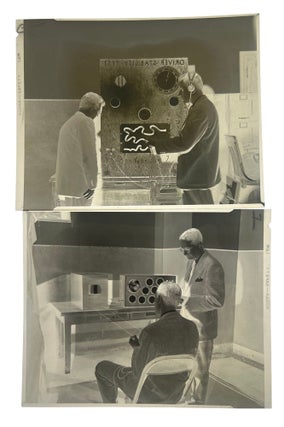
Post WWII driver safety education archive depicting apparatus-based traffic instruction in the United States, circa 1950, documenting the effort to make automobile behavior measurable through classroom testing, demonstration equipment, and supervised observation. The negatives precede the National Safety Council’s first Defensive Driving Course, introduced in 1964, and belong to the earlier period when schools, civic groups, insurers, police, and safety councils framed the driver as a subject for training rather than only licensing. The group records a transitional moment in American road safety, after wartime restraint and before the interstate era made speed, volume, and driver conduct central public issues.Photo archive of 12 large format black and white film negatives, 4 x 5 inches, United States, circa 1950. The negatives show suited men demonstrating and observing driver safety testing devices in a classroom or staged instructional room. Several images center on a wooden apparatus labeled “driver stability test,” with knobs, dials, wiring, a headset, and a lighted maze or road pattern used for hand-eye coordination testing. Other negatives show a seated man operating foot pedals and controls before a cabinet fitted with an eye chart, gauges, wiring, and sliding or rotating components. One series shows instructors gathered around a display board which bears the label ‘Maano Saf T Board, Emigsville, Pa.,’ identifying it as a commercial driver education teaching board. The negatives also depict visual testing, reaction measurement, note taking, and repeated instructor-student positioning around machines rather than open-road driving.
American traffic safety campaigns intensified during the early 1950s as federal and civic leaders treated highway deaths as a national problem. In 1953 Eisenhower met with business leaders on highway safety and called for saving 17,000 lives and $1.25 billion a year through accident reduction, and in 1954 Safe Driving Day asked Americans to go a single day without traffic accidents. These negatives show the educational machinery untended to improve road safety during a time of rapidly expanding automobile usage. Occasional handling marks visible on the negatives. Overall good condition. A concentrated visual record of the pre-defensive-driving safety classroom, where postwar automobile expansion turned driver behavior into an organized field of public instruction.
Item #23548
Price: $550.00
See all items in Other (American History), Transportation Systems, Urban Development & Industrialization, Technology, Engineering & Innovation
See all items in American History & Americana, Labor, Environment & Industry, Science, Medicine & Technology
See all items by Early Driver Safety Training
Suggested Transportation SystemsBrowse All





Suggested Other (American History)Browse All