United Auto Worker Strike Action at Ford's River Rouge Plant in Dearborn Michigan, Press Photo Archive, 1941-67
Photograph
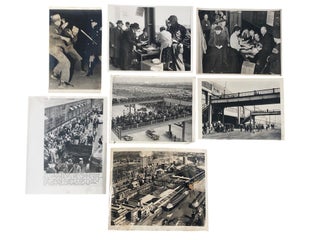
[Labor Organizing] Ford River Rouge plant press photographs documenting labor conflict, picketing, and union organization at the largest industrial complex in the United States from the early UAW recognition battles of 1941 through the major Ford walkouts of 1949 and 1967. The River Rouge plant in Dearborn employed tens of thousands of workers and was the center of Ford’s anti-union resistance during the rise of the Congress of Industrial Organizations (CIO). Ford Motor Company remained the last major Detroit automaker to recognize the United Auto Workers after General Motors and Chrysler signed contracts following the 1936-1937 sit-down strikes. Several scenes here connect directly to the April 1941 strike that finally forced Ford to negotiate with the UAW after years of union busting and company sanctioned violence against organizers. Later scenes document the 1949 strike involving roughly 65,000 workers and the 1967 Rouge walkout, documenting three decades of union activity in the American auto labor history.Photo archive of 9 black-and-white press photographs, silver gelatin prints, ranging from 7 x 9" to 8 x 11", Dearborn and Detroit, Michigan, 1941-1967. Photographs show UAW members at Rouge plant gates carrying placards reading “Ford Is On Strike,” while reporters and cameramen surround circular picket formations outside the factory entrances. One scene records women from the Women’s Auxiliary of UAW Local 600 marching in orderly formation with American flags during an April 1941 demonstration outside the Rouge complex. Another captures a state policeman advancing with baton raised as two men recoil during violence near a plant gate; the attached caption identifies one figure as an unidentified Black man striking a UAW picket captain. Additional scenes show workers waiting in line for pay envelopes during the strike, men gathered outside plant entrances under heavy guard, and a largely idle assembly floor where a lone foreman sits beside silent production lines after tens of thousands of workers walked out. Typed press captions affixed to versos on image margins, including references to the May 1949 strike and September 1967 Rouge picketing.
The Ford strikes were some of the most consequential labor battles in twentieth-century American industry. Ford’s Service Department under Harry Bennett built an extensive anti-union apparatus that used labor spies, intimidation, and physical violence against organizers, culminating in nationally publicized confrontations such as the 1937 “Battle of the Overpass.” The April 1941 strike represented the decisive collapse of Ford’s resistance to industrial unionism and secured UAW recognition at the Rouge plant, fundamentally changing labor relations in the American automobile industry. These scenes preserve not only the mechanics of organized strike action but also the scale of industrial labor mobilization in midcentury Detroit, where mass demonstrations were central in the struggle between organized labor and corporate management. Light creasing, scattered surface wear, and minor handling marks consistent with newsroom use; captions and editorial markings largely intact and legible. Overall good to very good condition.
Item #23431
Price: $885.00
See all items in African American Labor & Employment, Michigan, Industrialization, Manufacturing, and Infrastructure, Labor & Labor Movements, Women’s Labor & Employment
See all items in African American History, American History by State, Labor, Environment & Industry, Women’s History & Feminism
See all items by United Auto Workers Ford Motor Co
See all items in Michigan
Suggested Industrialization, Manufacturing, and InfrastructureBrowse All



Suggested MichiganBrowse All





Suggested African American HistoryBrowse All


Suggested American History by StateBrowse All