Peru Lantern Slides of Indigenous Life in the Perené and Cuzco, early 1900s
Photograph
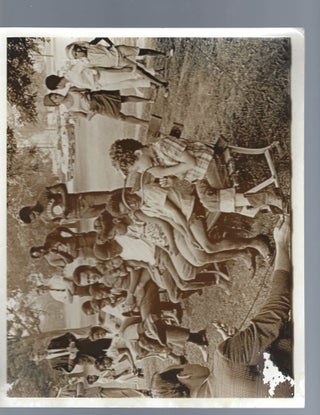
Peru glass lantern slide archive documenting Indigenous and rural life in the Perené and Cuzco, during a period where the political economy shaped was by export agriculture, regional extraction, and foreign institutional interest. In this period Peru was governed by a coastal elite tied to export markets and to the expansion of state and commercial control into the interior, and images of carriers, river craft, family groups, and gathered communities register how Indigenous people were affected by that process through incorporation into frontier economies while also being recast for North American educational audiences as ethnographic subjects.Photo archive of 6 black and white glass lantern slide photographs, each 3.25" x 4", Peru, early 1900s. Issued as lecture materials for the Philadelphia Museum. The group includes a family or community portrait posed before a thatched structure, with adults and children wearing brimmed hats, layered garments, shawls, and patterned skirts; a closer seated group of women and children gathered around large ceramic vessels; also includes a large outdoor crowd scene showing a densely gathered public space filled with adults and children; a posed family and community portrait before a rustic structure with men, women, and children wearing layered garments, shawls, and broad-brimmed hats; a closer domestic scene centered on seated women and children gathered around large ceramic vessels; a river crossing in the Rio Perené region showing an adult and child standing on a balsa or log raft using poles to navigate the current; an “Indian Carrier” posed beside a railroad car, linking Indigenous labor and movement to expanding transportation networks; and a closer portrait of an Indigenous man framed by a larger crowd gathered behind him. Several slides retain typed or manuscript labels including references to “Rio Perene” and “Hutchins Indian in Balsa,” while institutional labels read “The Philadelphia Museums” and “Negative by E. Tyson Hutchins / Use restricted to school lectures in museum,” establishing the archive as part of a formal educational and interpretive program rather than private travel photography alone.
The archive is particularly effective because it balances portraiture with broader communal documentation. The large crowd scene, family grouping, and market or gathering views shift the photographs away from isolated ethnographic “types” and toward visible social environments populated by children, laborers, families, and community members. The railroad image and river crossing additionally place Indigenous Peruvians within the transportation and frontier systems increasingly tied to trade, extraction, regional movement, and outside institutional observation in the early twentieth century. During the late nineteenth and early twentieth centuries, regions such as the central selva and Perené valley were increasingly bound to colonization schemes, plantation agriculture, and extractive enterprise, while Indigenous communities faced land pressure, labor demands, and outside scrutiny from state agents, missionaries, traders, and foreign observers. No cracks or chipping; crowd image lacking its original frame with glass and matte border loose; otherwise very good condition. A concise record of how Indigenous and local Peruvians were photographed within overlapping systems of frontier incorporation and museum interpretation.
Item #23217
Price: $850.00
See all items in World Indigenous Peoples, World Indigenous Peoples, Early Photography, Mexico, South & Central America
See all items in Indigenous Peoples, International & Global Culture, Photography, World History by Geography, Archive
See all items by Peru Indigenous Peoples
See all items in Peru
Suggested World Indigenous PeoplesBrowse All




Suggested Early PhotographyBrowse All

Suggested Indigenous PeoplesBrowse All




Suggested PhotographyBrowse All