African American Family Life and Community Vernacular Photography Archive, 1928–1960
Archive
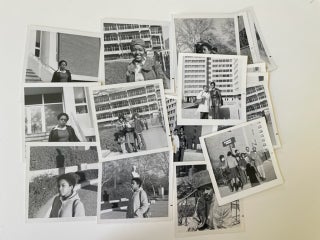
African American vernacular photograph archive, 1928–1960, documents Black family life, social networks, and everyday leisure across the decades spanning late Jim Crow segregation through the early Civil Rights era in Georgia. The archive provides sustained visual evidence of African American domestic stability, mobility, and self-representation during a period marked by systemic racial exclusion and legal segregation in the United States. Scenes include couples embracing, restaurant gatherings, birthday celebrations, children at play, studio portraiture, and leisure travel including boating, presenting a continuous record of Black life lived beyond institutional narratives of marginalization. One photograph from 1958 depicting a Black man embracing an elderly white woman on a residential porch introduces a rare visual instance of interracial intimacy within a period defined by rigid racial boundaries, while images of school-aged children, including those labeled “School Days,” situate the archive within the expanding but unequal educational landscape for African Americans prior to and following Brown v. Board of Education.Archive of 54 original vernacular photographs, including silver gelatin and Kodacolor prints, created between circa 1928 and 1960, with identified dates inscribed on twenty-four images including 1929, 1930, 1935, 1939, 1948, 1950, 1951, 1953, and 1954. One photograph is captioned “Savannah Georgia in 1953,” providing a geographic anchor within the segregated American South. The archive includes school portraits, studio portraits, informal domestic scenes, outdoor images, and urban settings. Several photographs bear inscriptions on the verso, including “To Aunt Bea with love, April 24, 1959,” indicating circulation within extended family networks. Notable images include a young Black man posed in a 1940s suit and fedora alongside U.S. Army khaki uniform elements during the World War II period, a child on a tricycle with her father, a mother with two children in a park, a sleeping newborn, and two girls posed before a sign reading “Real Leagues.” Photograph sizes range from approximately 2 x 1.5 inches to 7 x 5 inches, with most measuring around 4 x 2.5 inches. Taken together, the archive offers a longitudinal visual record of African American life across three decades that saw the Great Migration, World War II military service, and the early Civil Rights Movement reshape Black social and political experience. The presence of military-associated imagery aligns with broader patterns of African American enlistment and postwar demands for civil rights, while leisure scenes, family gatherings, and children’s portraits document continuity of community formation under segregation. The inclusion of dated photographs enhances the archive’s utility for reconstructing timelines of family and social history, while inscriptions and regional references provide anchors for localized study. Light toning present in some images, with occasional warping and minor edge cracking; most photographs remain sharp and legible. Overall very good.
Item #17811
Price: $750.00
See all items in African American Family & Community Life, Other (American History), Georgia
See all items in African American History, American History & Americana, American History by State, Archive
See all items by Black Vernacular Photography
See all items in Georgia
Suggested Other (American History)Browse All



Suggested GeorgiaBrowse All




Suggested African American HistoryBrowse All





Suggested ArchiveBrowse All