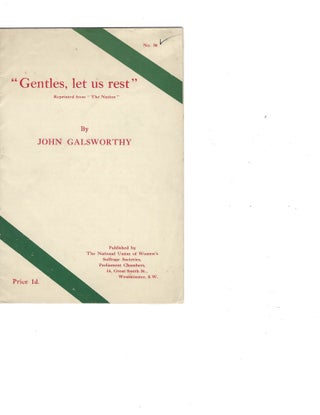
Women’s Suffrage John Galsworthy’s Gentles, Let Us Rest! and the Case for Women’s Political Equality 1913
Pamphlet
Galsworthy, John. Gentles, Let Us Rest!, circa 1913, presents the future Nobel laureate’s public argument for women’s political equality in an edition issued by the National Union of Women’s Suffrage Societies, Britain’s principal constitutional suffrage organization. Originally published in The Nation in 1910, Galsworthy’s essay addresses male readers and argues that continued resistance to women’s claims violated the ideals of justice, courtesy, and fair play that men professed to uphold. Galsworthy supported women’s suffrage while opposing militant tactics, and the NUWSS reprinted his argument as part of its campaign for constitutional enfranchisement. His position is explicit: women’s growing dissatisfaction with their political status required men to reconsider the laws and conventions maintained in their favor.Galsworthy, John. Gentles, Let Us Rest! Reprinted from The Nation. No. 56. [London]: National Union of Women’s Suffrage Societies, [1913]. 16 pages in original colored wrappers. Galsworthy directs his appeal specifically toward men, asking what honorable response remains if there exists “a great and ever increasing body of women suffering from a bitter sense of injustice.” He concludes by calling for an end to male resistance to women’s demands: “Has not, in truth, the time come for us to say” that the “bitter and ungracious conflict with those weaker than ourselves” should cease: “Gentles, let us rest!” The complete text makes clear that his argument extends beyond sympathy: he describes the suffrage movement as evidence of women’s striving toward political equality and asks men to grant fulfillment to that claim.
The pamphlet belongs to the NUWSS campaign for women’s suffrage through peaceful and constitutional methods. Galsworthy’s authorship gave the organization the published testimony of a prominent male novelist who framed enfranchisement as an obligation of male fairness rather than a concession extracted through militancy. His later writing confirms the distinction: in 1911 he explicitly described himself as “a supporter of woman’s suffrage, but not of militant suffragism,” while arguing that inadequate press coverage of peaceful suffrage work had contributed to the rise of militant tactics. Minor toning and foxing; overall good condition. An NUWSS publication documenting the organization’s use of male literary allies to address men directly on women’s political rights during the final years before the First World War.
Item #16259
Price: $285.00
See all items in Other (Law/Policy), Women’s Liberation & Feminism, Women’s Suffrage & Early Women’s Rights, Europe
See all items in Law, Incarceration & Public Policy, Women’s History & Feminism, World History by Geography
See all items by John Galsworthy Women’s Suffrage
See all items in England
Suggested Other (Law/Policy)Browse All



Suggested EuropeBrowse All


Suggested World History by GeographyBrowse All