John F. Kennedy Appointment Signed as President On Black Saturday, the Most Dangerous Day of the Cold War when Nuclear War was Most Imminent
Manuscripts & Autographs
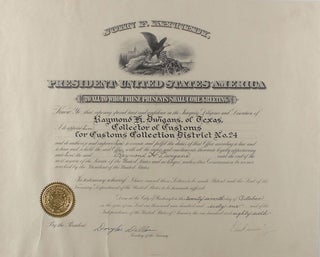
Kennedy, John F. 35th president of the United States. Document Signed as president. Washington, D.C.: October 27, 1962. Large folio (approx. 20 x 16 inches). The document is dated October 27, 1962 — referred to by historians as “Black Saturday”, widely regarded as the single most dangerous day of the entire Cold War, the moment when nuclear war came closest to occurring. On this day, U.S. strategic forces remained at DEFCON 2, the highest state of military readiness ever reached by the United States and one step short of full nuclear war. Strategic Air Command placed nuclear-armed bombers on continuous airborne alert, intercontinental ballistic missile crews on immediate launch readiness, and command authorities on constant emergency footing. Unlike abstract deterrence postures, DEFCON 2 signified that nuclear forces were fully prepared for imminent use, with decision timelines measured in minutes rather than hours. The shooting down of a U.S. reconnaissance aircraft over Cuba, combined with U.S. naval confrontations with Soviet submarines and the presence of nuclear weapons already deployed in the Caribbean, created a uniquely unstable environment in which miscalculation, miscommunication, or unauthorized action could have triggered catastrophic escalation. That this routine act of executive governance was carried out amid an active, unresolved nuclear standoff underscores the extraordinary historical context in which the document was signed, situating it at the precise moment when global nuclear war was a realistic and immediate possibility.The document is an oversized partly-printed commission appointing Raymond H. Dwigans, of Texas, as Collector of Customs for Customs Collection District No. 24, opening with the engraved heading “President of the United States of America” and the formal address to “all to whom these presents shall come.” It is signed by President Kennedy and countersigned by Treasury Secretary Douglas Dillon, reflecting the continued operation of federal authority and administrative continuity at a moment of extraordinary national crisis. Visually, the document features a patriotic engraved vignette at the head and a large embossed gold Treasury seal at lower left, following long-standing U.S. commission traditions. As a Kennedy presidential document signed at the precise height of the Cuban Missile Crisis, it stands as a tangible artifact of constitutional governance carried out under existential threat. Condition: Two small creases on lower part only, not affecting text or President Kennedy’s signature. Kennedy’s signature remains very clear and well-contrasted. The embossed seal is intact and crisp. This document was signed by President John F. Kennedy at a moment when presidential judgment carried unprecedented immediacy and consequence, the commission embodies the exercise of executive authority under conditions in which national survival hinged on decisions measured in minutes. As a contemporaneous artifact of governance enacted at the brink of nuclear war, it offers a rare convergence of material culture, historical timing, and presidential action at the most acute point of Cold War crisis. Overall very good condition.
Item #13501
Price: $8,500.00
See all items in U.S. Presidents, Cold War & Nuclear History
See all items in American History & Americana, Military & War, Exceptional Pieces , Autographs, Manuscripts & Letters
See all items by John F. Kennedy
Suggested U.S. PresidentsBrowse All
Suggested Exceptional PiecesBrowse All