Cold War Chemical Warfare and Bomb Disposal Training at Redstone Arsenal, Annotated Military Archive, 1981
Manuscript & Autographs
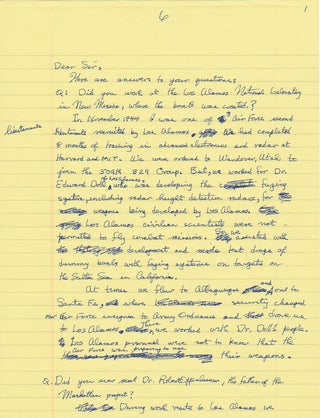
A Cold War explosive ordnance disposal (EOD) training archive documenting how U.S. military personnel prepared for the dangers of chemical warfare and unexploded munitions. Established near Huntsville, Alabama, during World War II, Redstone Arsenal and the neighboring Huntsville Arsenal manufactured and assembled chemical munitions before Redstone became a major center of Army rocket development and ordnance training. During the Cold War, the United States and Soviet Union maintained vast chemical weapons stockpiles. Toxic agents could cause severe injury or death and leave contaminated areas and dangerous munitions requiring specialist response. The instructional texts, annotated identification charts, handwritten notes, and training maps gathered here show how EOD personnel learned to recognize chemical munitions and assess the hazards they presented.Large archive of annotated printed materials associated with the US Army Missile and Munitions Center and School. Redstone Arsenal, Alabama, c. 1981. Large black three-ring binder bearing the Redstone Arsenal name and seal, comprising approximately 500 pages. Associated with Airman First Class James F. Stevens and C. Koshoffer. A Phase I student handbook for the U.S. Army Missile and Munitions Center and School’s Explosive Ordnance Disposal Course bears the name “A1C James F. Stevens.” C. Koshoffer’s name appears on handwritten EOD notes dated March 20, 1981, and on a chemical-agent testing sheet. The student handbook and accompanying materials cover missiles, chemical munitions, explosives, and the identification of hazardous ordnance. Force EOD notes dated March 20, 1981 record the hazards associated with “Chemical, Conventional, Nuclear” ordnance and the motto “Initial success or total failure.” Illustrated identification pages depict riot-control grenades, chemical and smoke projectiles, and a chemical warfare bomb, with highlighting and handwritten notes identifying their fillers and hazards. A color chart shows chemical munitions markings, while training maps bear handwritten wind directions and projected hazard areas.
The devastating use of poison gas during World War I and the chemical weapons arsenals maintained during World War II left a legacy that continued into the Cold War. The United States and Soviet Union stockpiled chemical weapons and trained personnel to recognize and respond to the dangers of toxic agents and contaminated munitions. The 1925 Geneva Protocol prohibited the use of chemical weapons in war but did not prohibit their production or stockpiling, leaving military personnel to prepare for the possibility of exposure and contamination. The extensive annotations, corrections, and highlighted passages preserve a direct record of how military personnel studied the weapons and hazards they might be called upon to confront. Pages show some toning, creasing, staining and reinforced or torn binder holes. Some loose inserts and missing pages. Overall in very good condition.
Item #24134
Price: $885.00
See all items in Alabama, Cold War & Nuclear History, Technology, Engineering & Innovation
See all items in American History by State, Military & War, Science, Medicine & Technology
See all items by Red Stone Arsenal Chemical Warfare
See all items in Alabama
Suggested AlabamaBrowse All


Suggested American History by StateBrowse All