USS Maryland letter archive documenting Scarlet Fever, American Imperial Expansion, and Enlisted Life aboard U.S.S. Maryland, 1904 to 1907
Ephemera
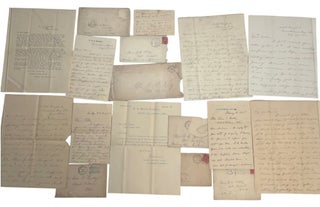
U.S. Navy correspondence, 1904 to 1907, of Gilbert Harold Kelly, documenting enlisted life aboard the newly commissioned armored cruiser U.S.S. Maryland during the expansion of American naval power after the Spanish American War. The letters document his movement from the recently established base at Guantánamo and Atlantic Fleet maneuvers through Naval Militia training ,to the ship’s transfer to the Asiatic Station amid continuing American rule in the Philippines, unrest in China, and the altered Pacific balance following the Russo Japanese War. One letter documents Kelly's 1905 scarlet fever infection in a letter from the hospital to his mother saying that her son was “seriously ill at this hospital with Scarlet fever,” with a later follow up “now out of danger, improving.” Other letters include Kelly's perception of the status divide between regular sailors and the Massachusetts Naval Reserves, explaining that the reserves were “to the Navy what the State Militia is to the Army” before adding, “We Real Sailors don’t like to have much to do with Naval Reserves.” An undated letter written before the ship’s eastward deployment describes “coaling ship and getting in stores preparatory to our China trip,” an enlisted sailor’s formulation for the deployment that carried Maryland through Mediterranean ports toward the Asiatic Station.Correspondence archive of 10 handwritten and typed letters, 16 leaves with 25 pages written, chiefly 1904 to 1907, sent from U.S. Navy stations and U.S.S. Maryland to Mount Gilead, Ohio. Kelly writes from Gardiners Bay, Provincetown, Guantanamo Bay, Palermo, Honolulu, and at sea, describing naval work and the routines surrounding it with unusual specificity. At Provincetown he reports that Maryland had come “to standardize our propellers on the Government course,” while at Guantanamo he records fishing and sailing parties, boat and swimming races, a smoker on the forecastle, and a fleet water carnival judged by three admirals in which Pennsylvania took first prize and Maryland second. “The Maryland gave a continuous vaudeville show,” he writes, describing a stage rigged across two boats, towed by a steam launch, with the ship’s band and sailors dressed as sideshow performers. His Mediterranean correspondence records liberty in Palermo, the city’s catacombs and architecture, and the commercial attention drawn by American crews: “Of course the Americans are spotted for easy marks and the price take a raise at sight of the U.S. ships.” He then places the squadron in motion with the concise report that “the Colorado is with us, while the W.V. and Pennsy are at Naples” and that the ships would meet the flagship at Piraeus, Greece. By September 1907 Kelly was writing from Honolulu after leaving Yokohama, explaining the International Date Line to his mother and calling the passage “the longest cruise we have ever taken, 3,500 miles without a stop,” during which “Not a single ship was sighted during the entire trip.” Several envelopes retain stamps, naval and civilian cancellations, and addresses to Mrs. B. C. Kelly at Mount Gilead; the Naval Hospital correspondence instead names Lina S. Kelly, preserving two forms of address within the family papers.
Kelly’s correspondence follows U.S.S. Maryland through the overseas naval network created in the aftermath of the Spanish American War, from maneuvers at the recently established Guantánamo station to the ship’s 1906 transfer to the Asiatic Station and passage across the Pacific. The U.S.S. Maryland, a 13,680 ton Pennsylvania class armored cruiser commissioned on April 18, 1905 under Captain Royal R. Ingersoll, entered the Atlantic Fleet that October, participated in the 1906 winter maneuvers off Cuba, and carried Massachusetts Naval Militiamen on a summer training cruise before preparing for transfer to the Pacific and Asiatic Station. Kelly’s letters supply the enlisted perspective behind that chronology, moving from technical trials and reserve training to Guantánamo fleet culture and the squadron’s passage east. A contemporary State Department report confirms Maryland, West Virginia, Pennsylvania, and Colorado together in the Bay of Phaleron on October 2, 1906 and records their departure “for the East” four days later, closely matching Kelly’s Palermo account and his reference to meeting the flagship at Piraeus. The scarlet fever notices belong to an earlier and more precarious stage of his service: federal mortality statistics for 1905 recorded a scarlet fever death rate of 6.8 per 100,000 within the national registration area, giving the hospital’s promise to telegraph Lina Kelly if her son became critical a contemporary medical gravity absent from later antibiotic era experience. Fold creases throughout, light to moderate toning and scattered soiling, with small paper losses to several sheets and postal covers; envelopes show expected opening and age wear. Letters remain clear and legible. Overall in very good condition.
Item #23904
Price: $1,250.00
See all items in Ohio, Other (American History), Imperialism & Colonialism, Medicine & Public Health, Mexico, South & Central America
See all items in American History by State, Military & War, Science, Medicine & Technology, World History by Geography, Autographs, Manuscripts & Letters
See all items by USS Maryland Letter Archive
See all items in Ohio
Suggested Other (American History)Browse All
Suggested OhioBrowse All





Suggested World History by GeographyBrowse All



Suggested American History by StateBrowse All