World War II American Soldier’s Photo Album Documenting the Vast Allied Transportation Network from Stateside Departure and Atlantic Military Transport to the Liberation of France, with Crowded Troop Transports, Army Camps, Jeeps, Rail Convoys, Wrecked Trains. 1942-45
Photograph
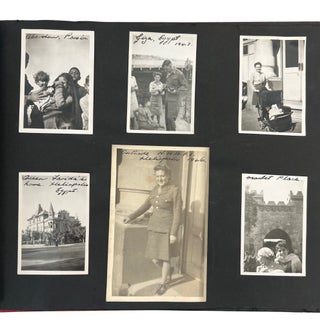
American soldier’s World War II photo album, 1942 to 1945, documenting the movement of American servicemen from stateside departure through transatlantic military transport, field encampments, rail and truck transit, and recently liberated France, including the physical ravages left by the fighting, bombing, sabotage, and German retreat. An inscription dated June 1942 records a going away party at Warfield, Virginia, establishing the stateside beginning of the wartime chronology, while later captions place the photographer or his companions in Lyon and traveling by train from Lyon to Vittel. Rather than concentrating on frontline combat, the album records the enormous transportation and staging apparatus that carried American personnel across the Atlantic and through the European Theater, as well as the damaged landscape through which they traveled: transport ships, trains, trucks, camps, ports, chow lines, formations, temporary quarters, wrecked railway cars, damaged infrastructure, and waiting soldiers recur throughout the photographs.Photo album of black and white photographs, United States and France, 1942 to circa 1945. The photographs show soldiers posed with Army jeeps; groups outside barracks and temporary buildings; men standing and relaxing among wooded tent encampments; soldiers waiting in formation; camp equipment and field installations; and large groups aboard military transports. Shipboard photographs record crowded decks packed with uniformed servicemen, men gathered around deck guns and fittings, cranes and port facilities, the open Atlantic, and soldiers standing at the rail during the crossing.
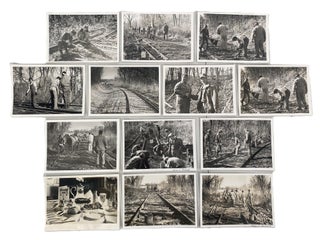
The European photographs follow American military movement inland through a France only recently wrested from German occupation, recording streets, railways, temporary assembly areas, damaged infrastructure, and French cities along the Allied route north. Handwritten captions identify “Chow line on train from Lyons to Vittel,” “Wrecked train cars,” “Waiting for trucks at the Palace de la Foire in Lyons,” “Castle De La Rive Lyons,” and “Part in front of monument in Lyons.” The wrecked railway equipment is particularly evocative of the destruction of France’s transportation system during the liberation, when Allied bombing, Resistance sabotage, German demolitions, and combat disrupted rail lines, bridges, locomotives, and rolling stock throughout the country. Several photographs show long formations of soldiers assembled in civic spaces and courtyards, while others record streets, bridges, riverfronts, public buildings, rail yards, and the urban fabric encountered by American servicemen moving through recently liberated territory.
A separate group preserves the civilian relationships surrounding the soldier’s service. One photograph is inscribed “Ernie’s going away party at Warfield, Va. Jerry, Pete, Ernie & I taken by Julie. (Wine) June 1942,” while other photographs show a father holding an infant, family members and friends, and studio or domestic portraits apparently exchanged during the war. Names occur on additional versos, but the surviving identifications do not establish which individual compiled the album.
The French sequence belongs to the dramatic Allied advance that followed Operation Dragoon, the invasion of southern France on August 15, 1944. After landing on the Mediterranean coast, the U.S. Seventh Army and French Army B drove north through the Rhône Valley against retreating German forces. Significant fighting occurred during this advance, including the battles around Montélimar in late August 1944, where American and French forces attempted to cut off the German Nineteenth Army as it withdrew northward. Lyon, an important transportation and industrial center that had endured German occupation, Allied bombing, Resistance activity, and German reprisals, was liberated in early September as German forces retreated north. On September 11, forces advancing from southern France made contact with Allied armies advancing eastward from Normandy, joining the two great invasion fronts.
From Lyon, the route toward Vittel in Lorraine carried American personnel into a region much closer to the increasingly severe fighting of the autumn of 1944. Eastern France and Lorraine became the scene of major operations as the U.S. Third and Seventh Armies pushed toward the German frontier. Fighting centered on cities and transportation corridors including Nancy, Épinal, Lunéville, Metz, and the Vosges, while retreating German forces and Allied air attacks left bridges, railways, rolling stock, roads, and communications damaged or destroyed. Vittel itself was liberated in September 1944 rather than being the site of a major set-piece battle, but it stood within this rapidly changing military landscape as American forces advanced through Lorraine and toward the Vosges and Alsace. The album therefore records not the battles themselves but something less commonly preserved: their immediate aftermath and the logistical machinery following behind the advancing armies. Its photographs move from crowded transatlantic military transports to tent cities and truck columns, from soldiers waiting for transportation in liberated Lyon to a chow line aboard a train heading toward Vittel, and from functioning military transportation to wrecked railway cars encountered along the route. The destruction visible in the photographs belongs to a transportation network that had become a central battlefield of the liberation of France, attacked by Allied aircraft and Resistance forces to impede German movements and, during retreat, sometimes demolished by German troops themselves.
The domestic photographs establish the other end of that process in June 1942, when departure for military service separated servicemen from families and social circles that continued to exchange photographs throughout the war. Light to moderate surface wear and occasional fading and silvering to photographs; album leaves show edge wear, detached or missing photographs at several mounts, and occasional loose prints. Overall in good condition.
Item #23768
Price: $880.00
See all items in Transportation Systems, World War II
See all items in International & Global Culture, Labor, Environment & Industry, Military & War
See all items by American soldier’s World War II photo album
Suggested World War IIBrowse All





Suggested Transportation SystemsBrowse All