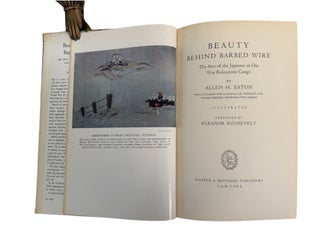
Japanese American Art During WWII Internment, Beauty Behind Barbed Wire, First Edition, 1952
First Edition
Japanese American art and craft survey published in 1952, documenting the cultural practices sustained within the War Relocation Authority camps during the Second World War. Allen H. Eaton records calligraphy, painting, embroidery, wood carving, miniature landscapes, flower arrangement, garden construction, and tea ceremony as practices carried into confinement and adapted to barracks, mess halls, and the materials available within camp boundaries. Photographs identify artists, teachers, and makers at Amache, Heart Mountain, Manzanar, Rohwer, Poston, Tule Lake, and other incarceration sites, preserving names and objects that official administrative accounts often treated as incidental to camp operations.Eaton, Allen H. Beauty Behind Barbed Wire: The Arts of the Japanese in Our War Relocation Camps. New York: Harper & Brothers, 1952. Foreword by Eleanor Roosevelt. Illustrated. 8vo. 128 pages. Eaton organizes the volume around the work produced by incarcerated Japanese Americans, with photographs and extended captions describing materials, makers, and camp settings. Subjects include pine bark panels carved at Amache; miniature landscapes developed at Amache; a Rohwer calligrapher whose skill was “deeply respected by his neighbors”; flower arrangement classes and exhibitions at Rohwer; Estelle Ishigo’s painting “Winter,” depicting snowbound barracks at Heart Mountain; ornamental entrances and planted yards at Poston and Manzanar; and tea ceremony classes at Tule Lake intended to preserve “dignity and poise while meeting difficult problems.” The frontispiece reproduces an embroidery made at Heart Mountain by Mrs. Makagawa, combining the camp barracks, barbed wire, and the snow covered mountain beyond.
Published a decade after Executive Order 9066 initiated the forced removal and incarceration of more than 120,000 people of Japanese ancestry, Eaton’s book shifted attention from federal policy and camp administration to the objects and environments created by those confined. Its pages record how residents transformed scrap lumber, desert plants, stones, discarded containers, and improvised tools into carved panels, gardens, bonsai, furnishings, paintings, and ceremonial spaces. Eleanor Roosevelt’s foreword places these works within a critique of wartime incarceration, while Eaton’s captions preserve both the language of the period and detailed evidence of artistic instruction, exhibition, and exchange inside the camps. Jacket heavily worn, stained, chipped, and torn, with substantial losses at the spine and upper edges; with text and illustrated pages generally clean and legible. Overall good condition. A detailed postwar record of cultural continuity, artistic labor, and the remaking of domestic and ceremonial space under Japanese American incarceration.
Item #23718
Price: $680.00
See all items in Other (Art/Visual Culture), Japanese American Internment, World War II
See all items in Art, Photography & Visual Culture, Asian American History, Military & War
See all items by Allen H. Eaton Beauty Behind Barbed Wire
Suggested Japanese American InternmentBrowse All


Suggested World War IIBrowse All




Suggested Other (Art/Visual Culture)Browse All
Suggested Asian American HistoryBrowse All