Oil Industry Foreigner in Meiji Era Japan Photo Archive Over 150 Annotated Photos, 1900s
Photograph
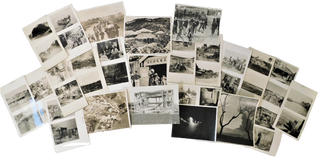
Turn-of-the-century Japan photo archive documenting foreign commercial travel, oil and mining activity, rural labor, and domestic life during the late Meiji era, when Japan was rapidly building railways, mines, refineries, modern ports, and industrial companies after the 1868 Meiji Restoration. The material appears connected to a Western man and his family moving through Japan in connection with oil extraction or related industrial work, with repeated views of derricks, refinery sites, pipe trenches, miners, labor crews, interpreters, servants, hotels, villages, and named regional destinations. Images show various scenes throughout northern Japan such as Hokkaido settlements, Sapporo gatherings, Naoetsu refinery work, Nara and coastal travel, household service, and encounters between foreign visitors and Japanese workers at a time when foreign technical knowledge and Japanese state-backed industrial growth were reshaping the country.Photo archive of more than 150 photographs, including approximately 6 cyanotypes and numerous silver gelatin and albumen photographs, sizes range between 2" x 3.5" to 4" x 6", Japan, circa late 1890s to early 1900s. Nearly every image bears a handwritten caption en verso identifying places, people, professions, work scenes, and social relationships. Captions include “Launching conveying pipe to and from steamship Corea Yokohama,” “Refinery location Naoetsu Japan,” “Celebrating the fall of Mukden, Sapporo, Mar. 21st, 1905,” “Crowd at Naoetsu Hotel,” “Working on foundation for refinery Naoetsu,” “Digging a great ditch for drain pipe from refinery to ocean,” “Drillers and visitors,” “Japanese servants at home in the bamboo grove,” “Old American Naval Hospital,” and “Mines & Smelters, Sumitake Hotel, Omori Japan.” Workers dig trenches, handle pipe, gather beside derricks and refinery structures, pose at mine entrances, stand near kilns and industrial yards, and move through villages and hotel courtyards. Other scenes record women in kimono, children, household staff, rickshaw pullers, street processions with rising-sun banners, thatched structures, coastal views, mission or hospital buildings, and Western family members partaking in local culture, seated in gardens, or standing among Japanese attendants and guides.
The archive records Japan’s industrial modernization from the perspective of foreign business presence rather than official state publicity. Oil had been produced in Japan since the nineteenth century, especially in regions such as Niigata, while Hokkaido mining, railway building, and settlement became central to Meiji development; this group places those broader changes inside fieldwork, travel, and household arrangements. The handwritten captions add another layer of specification by naming locations and functions that would otherwise be difficult to identify, especially the refinery and drilling views. Condition varies across the group, with curling, fading, toning, creasing, edge wear, occasional surface loss, and some with missing corners; images generally clean and clear, captions remain present and visible on many versos. Overall in very good condition. By the turn of the century, oil fields in Niigata and Akita were part of Japan’s push to build an industrial economy, but domestic crude was limited and often difficult to refine. The archive also reflects the unequal social and technical relationships that accompanied Meiji industrial expansion, with foreign commercial specialists, Japanese labor crews, domestic servants, and frontier extraction zones appearing together within the same industrial landscape.
Item #23395
Price: $880.00
See all items in Japan, Environment & Resources, Immigration & Migrant Labor, Labor & Labor Movements
See all items in International & Global Culture, Labor, Environment & Industry, Archive
See all items by Oil Industry Japan
See all items in Japan
Suggested Environment & ResourcesBrowse All


Suggested Labor & Labor MovementsBrowse All




Suggested Immigration & Migrant LaborBrowse All



Suggested JapanBrowse All