New York, Chicago & St. Louis Railroad and NYC Subway Photo Archive Documenting U.S. Rail Systems During the Great Depression, 1932-36
Photograph
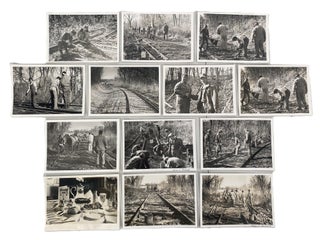
[Trains and Railroads][Urbanization] Nickel Plate Road photo archive documenting steam rail systems across New York and the Midwest, with additional views of New York City subway yard and NYC Board of Transportation activity, 1932-36. The photographs center the cross-country operation of the New York, Chicago and St. Louis Railroad, commonly known as the Nickel Plate Road, with images showing freight trains leaving yards, switchers handling cars, passenger service, enginehouse scenes, and terminals. All stamped with dates between 1932 and 1936 and the imprint of photographer Cameron Blaikie of Englewood, NJ, with come bearing handwritten ink caption indicating copy recipients. The group records Midwestern mainline railroading and New York’s subway system at a time when steam power, electrified transit, and large repair yards were essential American industrial and urban circulation.Photo archive of 16 silver gelatin photographs, 2.5 x 4 inches, Ohio, Indiana, and New York City,1932-36, Twelve photographs are captioned for the New York, Chicago & St. Louis Railroad or New York, Chicago & Saint Louis Railroad and include a “Nickel Plate Limited, westbound, leaving Hammond, Ind.,” a “Northbound freight train leaving yard at South Lima, Ohio,” an eastbound freight near Hammond, a “Six-coupled (0-6-0) type locomotive switching cars at Lima, Ohio,” a “Six-coupled (0-6-0) type switcher, Toledo, Ohio,” a “Six-coupled (0-6-0) type locomotive (converted from 2-8-0) in yard at Toledo, Ohio,” “Mikado (2-8-2) type locomotive at South Lima, Ohio, enginehouse,” and a “4-6-4 type locomotive.” The captions identify both location and function, distinguishing switching, yard departure, enginehouse activity, locomotive class, and passenger movement. Four photographs are captioned “City of New York, N.Y. Board of Transportation” and show the Eighth Avenue subway system at 207th Street, including “Shops and storage yard of the Eighth Ave. subway system (Independent system) at 207th Street,” “Train entering 207th St. yard from tunnel,” a broad terminal view described as “56 tracks wide, not all in picture,” and a work car “equipped with spools of electric cable which is attached to 3rd rail shoes of cars entering shop,” an unusually specific record of shop procedure and third rail handling. Across the group, recurring visual elements include multiple parallel tracks, telegraph poles, signals, towers, service buildings, freight consists, subway cars, and engines shown in motion or in work settings rather than static display.
The New York, Chicago and St. Louis Railroad served as a major Midwestern carrier linking Buffalo, Chicago, St. Louis, and intermediate industrial centers, and these photographs fix that system at the level of daily operation through named trains, locomotive classes, yards, and service points in Lima, South Lima, Toledo, and Hammond. The Board of Transportation views extend that operational focus into New York’s municipally run transit network, where the Independent Subway’s 207th Street facility handled car storage, repair, and electrical shop work on a large scale. Light surface wear, mild curling, and minor corner and edge wear; captions clear and photographs clean. The archive gives railroad, labor, and urban infrastructure collections a compact but sharply captioned record of how steam railroading and electrified rapid transit functioned in practice.
Item #23322
Price: $485.00
See all items in New York, Transportation Systems, Urban Development & Industrialization
See all items in American History by State, Labor, Environment & Industry, Archive
See all items by Chicago New York St. Louis Railroad
Suggested Transportation SystemsBrowse All



Suggested New YorkBrowse All





Suggested ArchiveBrowse All




Suggested American History by StateBrowse All