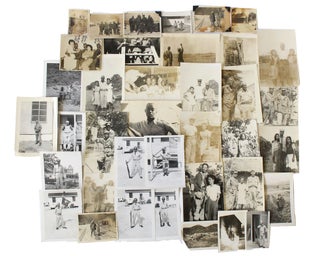
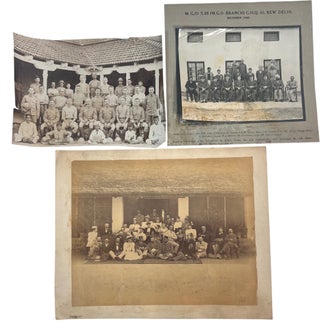
Early Identified South African Apartheid Archive of 83 Photos of Korsten, Port Elizabeth's Segregated Community, with handwritten Caption list, 1950s
Photograph
South African apartheid photo archive belonging to "M. Adams" documenting the segregated community of Korsten, Port Elizabeth, through vernacular photographs capturing sanitation, labor, schooling, health care, and everyday life through portraiture and street photography. A contemporary handwritten inventory headed “Slums of Korsten, Port Elizabeth, S.A.” links individual photographs to subjects ranging from church services, basket-making, and an African landlord’s house, preserving the neighborhood through the civic and economic structures that organized daily life. Korsten became one of Port Elizabeth’s major sites of forced removal in the 1950s, placing these photographs among the surviving street-level records of the area before its destruction.Photo archive of 83 silver gelatin photographs, ranging from approximately 4.5 x 2.5 to 4.5 x 3.5 inches, Port Elizabeth, South Africa, circa 1950s. Accompanied by a legible two-page handwritten inventory numbered 1 to 56 and titled "Slums of Korsten, Port Elizabeth, S.A.," with the compiler's address noted as "M. Adams, 25 Holland Road, London W14"; several versos carry pencil numbers and filing marks. The photographs show rows of corrugated metal and timber shacks, narrow dirt streets along Durban Road (Korsten's main thoroughfare), women carrying water from a communal tap, outdoor washing and cooking scenes with buckets and basins over open fires, a communal toilet, and families posed in doorways and beside shack walls. Inventory entries identify subjects including an "African broom seller," a worker in an old army coat, a "well-to-do African landlord," an African minister, basket-makers, and a "crowd watching a fight." Religious and educational life appears through an African church and school and the minister's house. A substantial recreation sequence captures an African wedding party, cricket matches between African and Indian teams with full crowds along the boundary, and a football team posed before a tournament. Additional views extend to street scenes, a shopfront with Coca-Cola signage, larger houses at the settlement's edge, and the open ground surrounding Korsten, broadening the archive into a wider localized survey.
Port Elizabeth's segregationist landscape was shaped well before 1948 and then intensified under apartheid legislation that divided urban space by race, restricted residence, and reorganized access to services and movement. Korsten held a central place in that process, and these photographs preserve the neighborhood at street level through repeated attention to taps, toilets, schools, work clothes, playing fields, and shack construction, the exact points where municipal control and everyday survival met. The numbered manuscript inventory gives the archive unusual documentary precision, linking individual photographs to a contemporaneous descriptive scheme and preserving a ground-level record of Korsten before its destruction by forced removal. Light creasing and folding from age and handling; inventory sheets folded and toned but fully legible; photographs otherwise clean and well preserved. Overall good condition.
Item #23273
Price: $885.00
See all items in Imperialism & Colonialism, Travel & Cultural Photography, Africa
See all items in Military & War, Photography, World History by Geography, Archive
See all items by South African Apartheid
See all items in South Africa
Suggested AfricaBrowse All




Suggested PhotographyBrowse All



Suggested ArchiveBrowse All




Suggested World History by GeographyBrowse All