LGBTQ+ History Lesbian Pulp Fiction and the Pathologizing of Female Same Sex Desire in Postwar Print Culture 1956 to 1964
Collection
Marr, Reed; Richards, Donna; Des Cars, Guy; Wade, Carlson; Kemp, Kimberley. Lesbian pulp novels published between 1956 and 1974 document the circulation of same sex desire within mid twentieth century popular publishing under conditions shaped by censorship, medical discourse, and Cold War social regulation. Issued as inexpensive mass market paperbacks, these works frame lesbian identity through narratives of criminality, institutionalization, psychological diagnosis, and moral deviation while simultaneously providing some of the only widely distributed representations of queer women available to readers during the period. The archive supports research into the intersection of sexuality, print culture, and mid century social control, including how publishers balanced sensational content with moralizing frameworks to satisfy obscenity restrictions and commercial demand.Archive consists of five mass market paperback volumes published between 1956 and 1974 in the United States and Australia, each in illustrated wrappers and typical 12mo format. Titles are as follows: [1] Marr, Reed. Women Without Men. Greenwich, CT: Fawcett, 1957. Set within a women’s prison environment, the narrative asserts that inmates “became as beasts” within conditions of confinement, situating lesbian desire within carceral space and behavioral breakdown. [2] Des Cars, Guy. The Damned One. New York: Pyramid, 1956. First U.S. translation from the French. Promoted with the question “What made her act like a man,” the novel examines gender nonconformity and butch femme dynamics through a European narrative lens. [3] Wade, Carlson. The Troubled Sex. New York: Beacon Envoy, 1961. A hybrid text combining pulp narrative and pseudo clinical framing, described as a “frank and penetrating study of habits and practices among lesbians,” presenting case study language alongside sensational content. [4] Richards, Donna. The Perfumed Flesh. New York: Domino Books, 1964. Described as a narrative in which a “charm school lured girls to a new life,” the novel situates same sex relationships within institutional grooming and hidden social networks. [5] Kemp, Kimberley. Forbidden. Sydney: Scripts, 1974. Advertised through the line “she began with a harmless experiment… but could not do without more of the forbidden fruit,” the work reflects later developments in the genre, incorporating themes of self awareness within a continued rhetoric of moral risk.
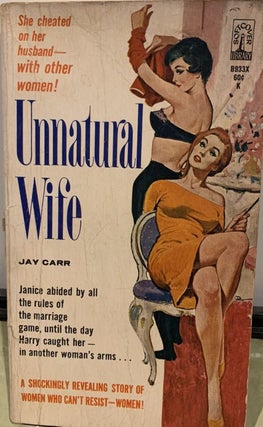
These publications were distributed through national paperback networks during a period when same sex relationships were frequently classified as criminal or pathological in both legal and medical frameworks. Publishers relied on coded language, moral warnings, and institutional settings such as prisons, schools, or clinics to legitimize depictions of lesbian relationships while maintaining compliance with obscenity standards. The cover art and promotional text emphasize tension between visibility and stigma, presenting desire as both spectacle and subject of regulation. Light rubbing and edge wear across volumes with occasional creasing and mild spine lean; bindings intact; overall good to very good condition. This grouping provides concentrated evidence of how lesbian identity was constructed, mediated, and circulated within mid century mass market literature prior to the emergence of openly queer publishing movements.
Item #21964
Price: $750.00
See all items in Lesbian Literature & Pulp, Pulp Novels
See all items in LGBTQ+ History, Literature & Literary Archives, Archive
Suggested Pulp NovelsBrowse All




Suggested LGBTQ+ HistoryBrowse All




Suggested ArchiveBrowse All