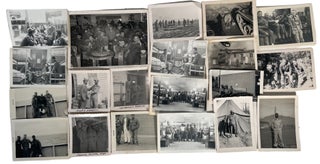
African American Social History Photographic Archive of Black Life in the Jim Crow South Across Tennessee, Georgia, Mississippi, and Louisiana, ca. 1930s–1941
Photograph
[African American] Southern African American life photographic archive, ca. 1930s–1941, documents everyday life and community environments of Black residents across several states of the American South during the Jim Crow era. The photographs depict rural and urban scenes from Tennessee, Georgia, Mississippi, South Carolina, and Louisiana, presenting visual evidence of African American childhood, labor, street life, and community interactions in a segregated society. Many of the images center on children and youth, offering insight into the social worlds of Black families during a period defined by legal segregation, racial hierarchy, and limited economic opportunity. The archive also includes imagery that reflects how African Americans were portrayed and labeled within contemporary photographic practice, with several captions such as “Study in Black” and “Way Down South,” language that reflects period attitudes toward race and regional identity during the early twentieth century.Archive of thirty black-and-white photographs mounted on loose album pages with typed captions, accompanied by the front page of The Commercial Appeal, Hotel Peabody Edition, Memphis, Tennessee, likely 1941, all attached to thicker roughly cut sheets. The photographs depict a wide range of scenes across the American South, including children playing outdoors, street and neighborhood views, and small group portraits. Two photographs carry typed captions identifying “Flower Vendors, Charleston,” while another set of three images labeled “River Boat Scenes” in New Orleans shows four young Black boys gathered near a Mississippi River vessel. Several photographs captioned “The Old South Lives Again” present scenes referencing historical memory in the region, including a Black woman caring for a white infant, a Black man wearing a nineteenth-century style top hat with an Audubon ribbon, and an elderly woman identified at the “Wishing Stone at Windy Hill.” Additional photographs document children walking along rural roads, groups gathered in public spaces, and everyday moments of Black youth and family life throughout the region. Some images retain pencil annotations in the lower margins, and most captions appear to have been typed directly onto the prints.
Photographs mounted on loose album pages, approximately thirty images plus one newspaper front page, the prints generally measuring small snapshot size and attached to thicker backing sheets. Light handling wear and minor edge irregularities to the album pages consistent with age; photographs remain clear with strong contrast and well-preserved detail; overall very good condition. As a coherent visual record of African American life across multiple Southern states during the Jim Crow era, the archive offers documentary evidence of Black childhood, community activity, and the visual language used to represent race and regional identity in the early twentieth-century American South.
Item #20343
Price: $880.00
See all items in African American Family & Community Life, Other (American History), South Carolina, Tennessee
See all items in African American History, American History & Americana, American History by State, Archive
See all items by Black Life in The Jim Crow South
Suggested Other (American History)Browse All







Suggested South CarolinaBrowse All




Suggested TennesseeBrowse All



Suggested African American HistoryBrowse All