Mexican Agricultural Life Rural Labor and Family Portrait Photography Documenting Post Revolutionary Countryside 1920s to 1940s
Archive
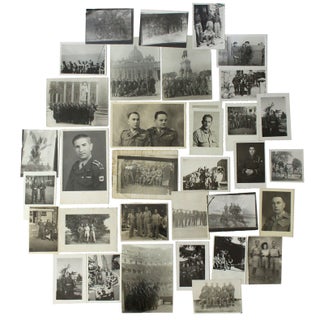
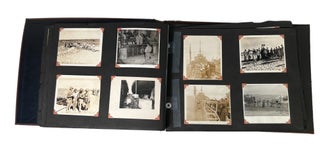
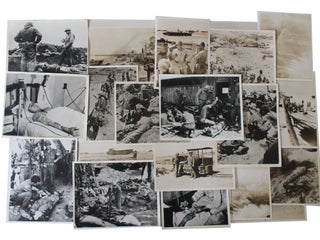
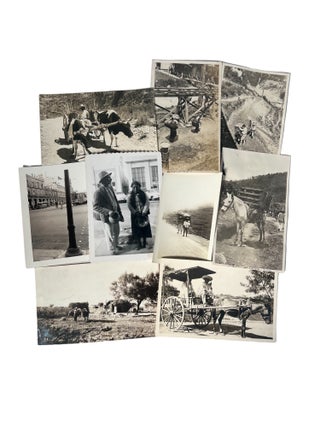
Photographers unknown. Rural Mexican agricultural photographs (circa 1920s–1948). This group documents daily labor, transport, and domestic life among campesino communities in Mexico during the decades following the Mexican Revolution, when land redistribution policies reshaped rural economies and agricultural production. The images record men, women, and children engaged in subsistence and small-scale farming activity, including the movement of goods, care of livestock, and domestic craft production, providing visual evidence of how rural populations sustained livelihoods within newly restructured landholding systems. The presence of wagons, pack transport, and adobe dwellings situates these scenes within regional agricultural practices that persisted alongside modernization efforts in early twentieth-century Mexico.Nine photographs including silver gelatin prints and real photo postcards, measuring approximately 2.75 x 4.5 inches to 3.5 x 5.5 inches, several with manuscript inscriptions on the verso. The images include multiple scenes of men riding wooden wagons pulled by cattle and equine animals; two postcards depict rancheros in wide-brimmed hats seated on wagons, one drawn by a mule and another by a team of bulls. Two photographs show individuals carrying heavily loaded baskets and packs of agricultural goods along arid pathways, one adjacent to a railroad line indicating proximity to transport infrastructure. A landscape postcard presents a young boy standing beside family cattle in front of an adobe and thatched dwelling, with harvested crops stacked behind him. A dated 1948 portrait taken in Tijuana depicts a man and woman holding earthenware pottery and wearing woven straw footwear, linking agricultural labor with artisanal production and local material culture.
These photographs align with broader transformations in rural Mexico during the post-revolutionary period, when land redistribution and agrarian reform restructured ownership while leaving everyday labor practices largely dependent on manual work, animal power, and localized exchange. Visual documentation of campesino life from this period provides primary evidence for the study of agricultural economies, regional identity, and material culture, particularly in relation to transport methods, housing forms, and dress. The combination of portraiture and working scenes situates individuals within their economic environment, offering insight into how rural communities organized labor and family life in the early twentieth century. Light wear, minor edge toning, and occasional surface marks; images remain sharp with strong contrast and legible inscriptions. Overall very good condition.
Item #20107
Price: $550.00
See all items in Borderlands, Border Wars, Mexican Revolution, Borderlands, Border Wars, Mexican Revolution, Travel & Cultural Photography, Mexico, South & Central America
See all items in Chicano & Latin American History, Military & War, Photography, World History by Geography, Archive
See all items by Mexican Agricultural Workers Photography
Suggested Borderlands, Border Wars, Mexican RevolutionBrowse All





Suggested PhotographyBrowse All


Suggested ArchiveBrowse All




Suggested World History by GeographyBrowse All