Battle of Iwo Jima Intelligence Failures: July 1944 U.S. Reconnaissance Report Documenting Motoyama Airfields and Coastal Defenses
Archive
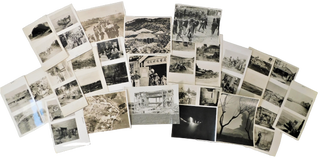
Reconnaissance photograph report of Iwo Jima dated July 4, 1944 documents United States military aerial intelligence gathering seven months before the February 19, 1945 launch of Operation Detachment and provides direct evidence of pre-invasion strategic assessment in the Pacific Theater of World War II. Produced in the immediate aftermath of U.S. naval bombardments that began on June 15, 1944, these photographs record beaches, airfields, and defensive installations targeted for eventual seizure by U.S. Marine forces. The images identify Motoyama Airfields No. 1 and No. 2, the “eastern boat basin,” Suribachi Yama, Chidoriga Hara, radio stations, entrenchments, taxiways, and a Radio Direction Finding tower, situating the material within the broader campaign to secure a midpoint air base between Tokyo and the Mariana Islands. The report’s detailed attention to terrain features described as “steep terraces,” “rugged interior,” and “steep cliffs” underscores its function as operational planning intelligence at a decisive phase of Allied Pacific strategy.Fifteen original photographs, numbered II through XVI and mounted on paper with typed descriptive captions, dated July 4, 1944. Images measure approximately 5 x 7 inches to 6 x 7 inches, each mounted on sheets approximately 8 x 13 inches, evidently prepared as part of a formal military reconnaissance report; photograph I is not present. The photographs depict smoke rising from the Motoyama Airfield area, a wrecked vessel in the eastern boat basin, coastline and beach approaches, and the island’s southern to northeastern terrain. Captions identify strategic landmarks and defensive attributes including Suribachi Yama and Moto Yama and note observable installations such as radio stations, entrenchments, and airfield infrastructure.
These photographs predate the Battle of Iwo Jima by seven months and were created during a period when U.S. intelligence assessments projected a rapid capture of the island. They do not reference the extensive underground tunnel and bunker network engineered under Lieutenant General Tadamichi Kuribayashi, who, following directives from Prime Minister Hideki Tojo, organized a defense centered on concealed artillery positions and approximately eleven miles of interconnected tunnels rather than beach-line resistance. American planners, relying in part on aerial reconnaissance such as this, anticipated that sustained bombardment had neutralized much of the Japanese garrison. The subsequent battle lasted thirty-six days and resulted in nearly 7,000 U.S. Marines killed and approximately 20,000 wounded; of roughly 21,000 Japanese defenders, only 216 were captured alive, and 22 Marines received the Medal of Honor for actions on the island. Light curling and toning to photographs; mounts exhibit moderate toning, soiling, and minor edge chipping. Overall good to very good condition. Substantive primary documentation of pre-invasion military intelligence immediately preceding one of the most consequential and costly amphibious operations of the Second World War.
Item #17083
Price: $1,000.00
See all items in World War II, Japan
See all items in Military & War, World History by Geography, Archive
See all items by Iwo Jima Invasion World War II
Suggested World War IIBrowse All




Suggested JapanBrowse All


Suggested World History by GeographyBrowse All



Suggested ArchiveBrowse All