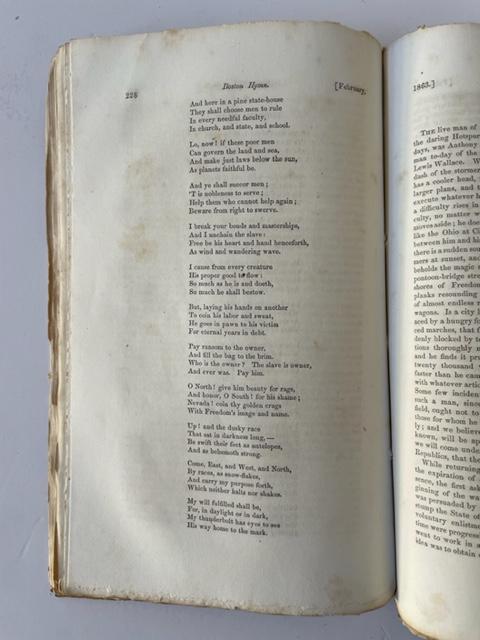
Civil War Emancipation and Abolitionist Poetics in Emerson’s “Boston Hymn,” Atlantic Monthly, February 1863
First Edition
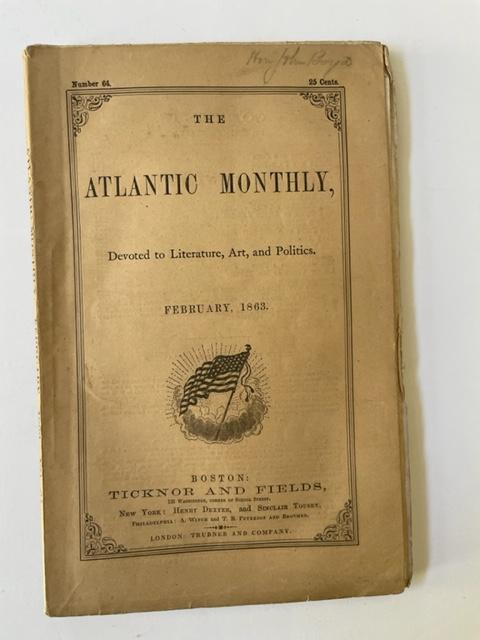
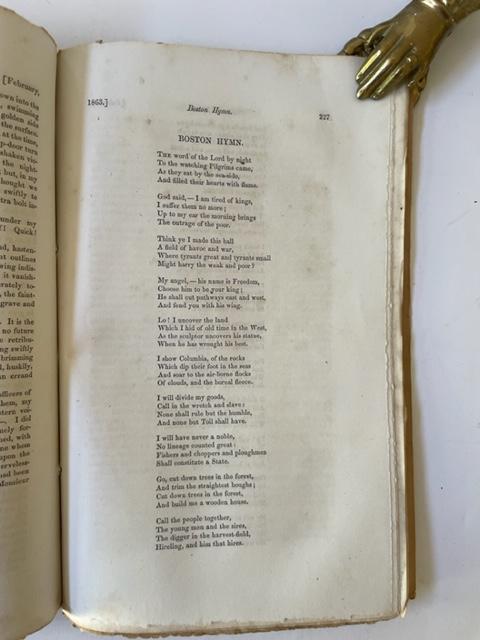
Emerson, Ralph Waldo. “Boston Hymn” (1863), printed in the February 1863 issue of The Atlantic Monthly, constitutes one of the earliest periodical appearances of his poetic response to President Lincoln’s Emancipation Proclamation and stands as a direct literary intervention in the political crisis of slavery and civil war. Written at the request of Boston organizers for the January 1, 1863 celebration marking the Proclamation’s issuance, the poem was first read by Emerson at Boston Music Hall the same day Lincoln’s order took effect. In “Boston Hymn,” Emerson situates emancipation within a providential and constitutional lineage, explicitly aligning the Proclamation with the Declaration of Independence while declaring the abolition of slavery a fulfillment rather than a departure from American founding principles. His verse rejects compensation to enslavers and instead demands justice for the formerly enslaved: “Who is the owner? The slave is the owner, / And ever was. Pay him.” The poem thus places emancipation within a moral economy grounded in restitution and national accountability.Emerson, Ralph Waldo. “Boston Hymn.” In The Atlantic Monthly; A Magazine of Literature, Science, Art and Politics. Boston: Ticknor and Fields, February 1863. Issue No. 64. The poem appears within the continuously paginated issue (pp. 146–272 plus advertisements). Original tan printed wrappers with vignette of the American flag; original advertisements present, including pink advertising slip with affixed newspaper clipping; early ownership inscription “Hon. John Boyd” in pencil to front cover. This issue followed closely upon the poem’s January 24, 1863 appearance in Dwight’s Journal of Music, placing it among the earliest print disseminations of Emerson’s Emancipation commentary in a major national literary periodical.
The February 1863 issue appeared at a decisive stage of the Civil War, as emancipation shifted Union war aims toward abolition and Black freedom. Emerson, already among the nation’s most visible intellectuals, used the poem to frame Lincoln’s executive act as a moral correction to constitutional compromise and as a theological affirmation of human equality. His public reading before approximately 3,000 attendees, delivered without advance notice of his participation, amplified the poem’s symbolic force in Boston’s abolitionist culture. As printed in The Atlantic Monthly, a leading forum for literary and political discourse, the text entered national circulation at the moment emancipation became federal policy. Light wear to wrappers; minor age toning; contents complete with advertisements; pink advertising slip present; small penciled ownership inscription to cover. Overall very good condition. A significant Civil War–era periodical issue preserving an early printing of Emerson’s poetic defense of emancipation and moral governance.
Item #15814
Price: $1,200.00
See all items in Slavery & Abolition, Civil War, Massachusetts
See all items in African American History, American History & Americana, American History by State
See all items by Ralph Waldo Emerson
See all items in Massachusetts
Suggested Civil WarBrowse All
![Women’s Suffrage] [Abolition] Julia Ward Howe Autograph Letter on Speaking Engagements and. Julia Ward Howe.](https://maxrambod.cdn.bibliopolis.com/pictures/16028.jpg?width=320&height=427&fit=bounds&auto=webp&v=1623976896)

Suggested MassachusettsBrowse All





Suggested African American HistoryBrowse All




Suggested American History by StateBrowse All