History of Computing William A Higinbotham Signed Typescript 1990 Article on Origins of Pong and Early Video Games
Manuscripts & Autographs
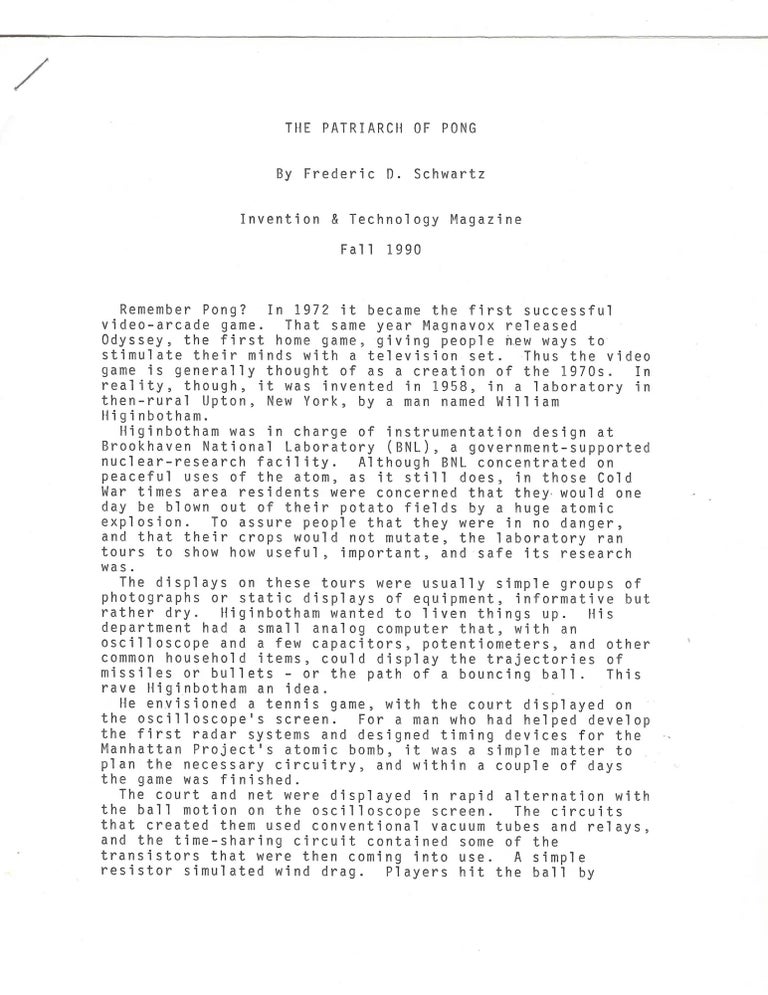
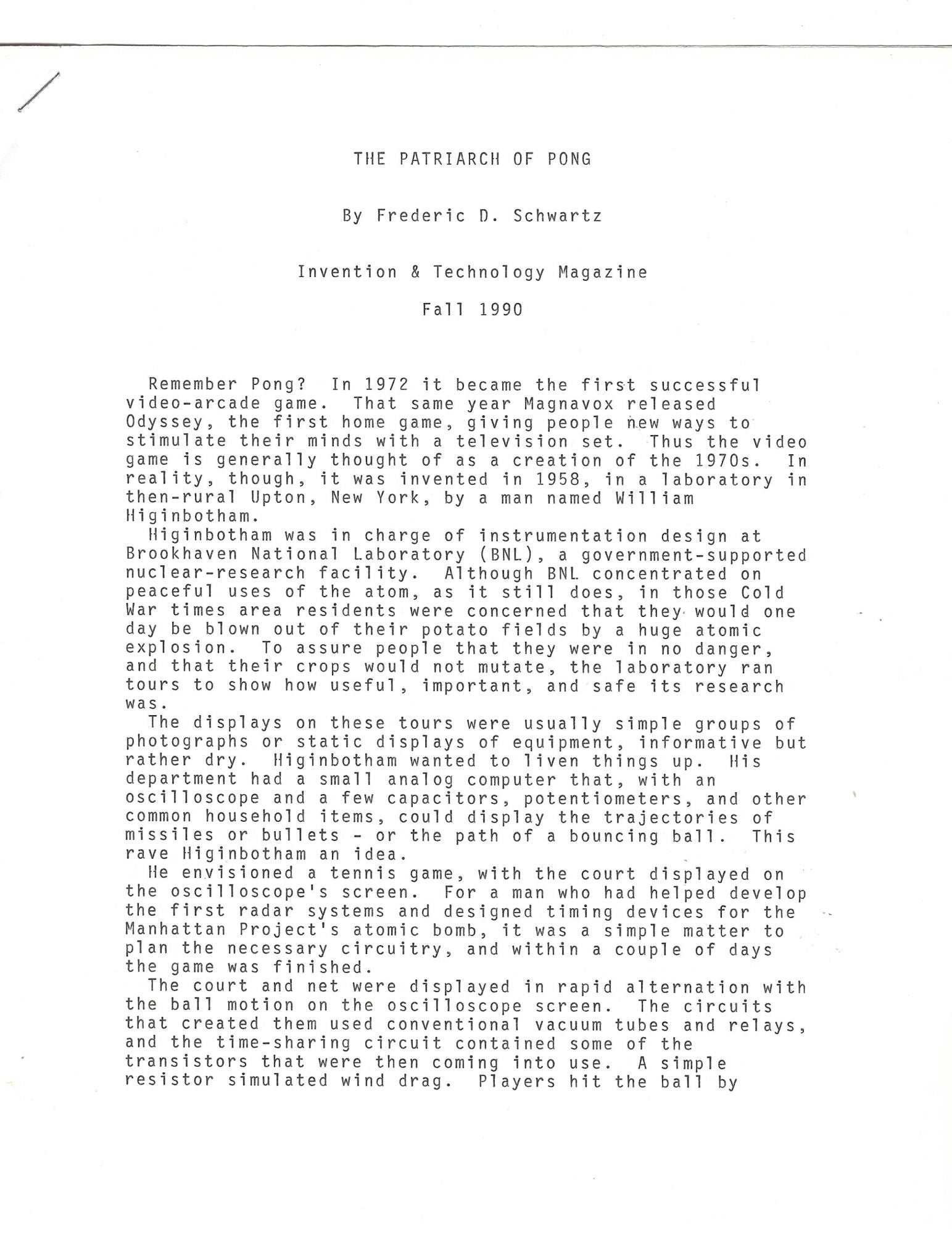
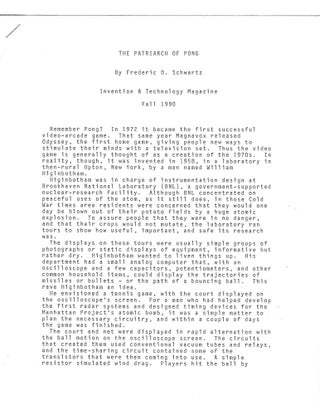
Higinbotham, William A. Signed typescript of Frederic D. Schwartz’s 1990 article on the origins of early video games documents the role of a nuclear physicist in the development of interactive electronic entertainment later associated with Pong. Higinbotham, a scientist at Brookhaven National Laboratory, created an oscilloscope-based tennis simulation in 1958 as part of public demonstrations designed to make atomic research accessible and non-threatening during the Cold War. The document situates the origins of video gaming within a government laboratory environment connected to earlier wartime research, including instrumentation work linked to the Manhattan Project. The text provides primary evidence of how scientific expertise developed for military and nuclear purposes contributed to the emergence of recreational digital technologies.Higinbotham, William A. Signed typescript of “Remember Pong?” by Frederic D. Schwartz. [New York]: Invention and Technology Magazine, 1990. Three pages, signed on page three, “Best Wishes, William A. Higinbotham Feb. 8, 1991.” The article opens: “Remember Pong? In 1972 it became the first successful video-arcade game… In reality, though, it was invented in 1958… by a man named William Higinbotham.” The text describes Higinbotham’s position overseeing instrumentation design at Brookhaven and explains the development of a “tennis game, with the court displayed on [an] oscilloscope’s screen.” It further notes the institutional context of government employment, stating that patent rights would have belonged to the federal government, preventing personal ownership of the invention.
Produced at the end of Higinbotham’s life, the signed typescript frames early video game history through the perspective of a scientist who had witnessed the first atomic test and later advocated for nonviolence and nuclear restraint. The article connects Cold War scientific culture with the emergence of interactive media, emphasizing how technologies designed for warfare and research environments were adapted for public engagement and entertainment. Higinbotham’s stated intention to create a nonviolent diversion underscores a countercurrent within late twentieth-century debates over digital media and violence, positioning the document within broader discussions of ethics in technology development. Light wear from handling; stapled at upper left; text and signature clear; overall in very good condition.
Item #14976
Price: $650.00
See all items in Popular Culture, Early Computing
See all items in Mass Media & Popular Culture, Science, Medicine & Technology, Autographs, Manuscripts & Letters
See all items by Early Computer Game Pong
Suggested Early ComputingBrowse All


Suggested Popular CultureBrowse All




Suggested Science, Medicine & TechnologyBrowse All



Suggested Mass Media & Popular CultureBrowse All