Iranian History and Early Projection Photography, Five Lantern Slides of Qajar Tehran, Isfahan, Mosque Prayer, and Persepolis, circa 1905
Photograph
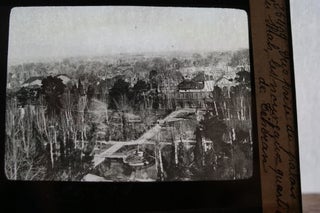
Radiguet, Arthur, and T.H. McAllister, collection of five lantern slides of Iran, circa 1905, documents Qajar-era urban, religious, royal, and archaeological sites as they were circulated through early twentieth-century photographic projection. The group records Tehran palace and garden settings, Isfahan’s Khaju Bridge, Muslim worship inside a Persian mosque, and the ruins of Persepolis, giving the slides research value for the study of Iran’s visual presentation to Western lecture audiences, the commercial lantern-slide trade, and the intersection of Qajar modernity with older Safavid and Achaemenid monuments. Qajar rule extended into the early twentieth century, ending in 1925, making these images especially relevant to the final decades of the dynasty and to foreign visual consumption of Iranian architecture, devotion, and royal space.Five gelatin silver bromide positive glass lantern slides, circa 1905, showing locations in Tehran, Isfahan, and Persepolis; each slide measures approximately 3 1/4 by 4 inches. The first image shows a Persian man in traditional dress walking within the Qajar Royal Palace and gardens; the second is an elevated view labeled “the Shah’s gardens and the new neighborhoods,” showing Tehran’s royal garden landscape and adjacent urban development without enough evidence to confirm the method of photography. The third image shows the Khaju Bridge in Isfahan, built under Shah Abbas II on the foundations of an earlier bridge and functioning as both bridge and weir across the Zayandeh River; the fourth shows a group of Muslims kneeling in prayer beneath a mosque archway; the fifth shows the ruins of Persepolis, the Achaemenid capital founded by Darius I in 518 B.C. and later designated a UNESCO World Heritage Site. Three slides are attributed to Arthur Radiguet of Maison Molteni, a French maker associated with lantern projection and slide production, while the Khaju Bridge slide was produced by T.H. McAllister, a New York firm known for selling magic lantern equipment and images.
The set brings together dynastic Tehran, Safavid civic architecture, Islamic devotional practice, and ancient imperial ruins, offering a compact visual itinerary of Iran as framed for projected instruction or entertainment around 1905. The Khaju Bridge image is particularly useful for architectural history because the bridge linked the Khaju quarter with the Zoroastrian quarter and combined circulation, water management, and public gathering functions; the Persepolis image extends the group’s chronology from modern Qajar Iran back to Achaemenid antiquity. Minor edge wear and light surface wear to glass mounts, with images remaining legible; overall very good. A focused group of early photographic projection images of Iran, useful for documenting how Qajar-era Tehran, Isfahan, mosque interiors, and ancient Persian ruins were presented through the international lantern-slide market.
Item #14425
Price: $400.00
See all items in Iran, Middle East
See all items in International & Global Culture, Photography
See all items by Qajar Iran
See all items in Iran
Suggested Middle EastBrowse All



Suggested IranBrowse All
Suggested PhotographyBrowse All