Science Fiction Fanzines Documenting Women’s Political Participation, Fan Identity, and the Reception of Feminist Comix, 1958-1971
Periodical
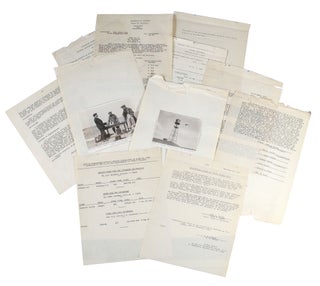
Archive of four issues of “Horizons,” “Heute,” and “Chatter,” documenting the literary and social life of science fiction fandom, 1958–c. 1971. Harry Warner, Jr.’s two substantial issues of “Horizons” contain fiction, personal essays, and commentary on amateur publishing, including Edgar Allan Martin’s “The Youth of Man,” a story of archaeology and telepathy, and debates over FAPA membership and the fanzine Hugo. In “Heute,” Peggy Rae Pavlat discusses reading Asimov, Heinlein, and Hal Clement and the friendships that prompted her return to fan publishing, alongside firsthand observations from the 1968 Humphrey–Muskie campaign. Dennis Richard’s “Chatter” circulates a contemporary review of “It Ain’t Me Babe,” the pioneering feminist underground comic. Together, the issues show how fan publications sustained discussion of science fiction while providing a forum for political testimony, cultural criticism, and debate over the community’s own institutions.Archive of four science fiction fanzine issues. Hagerstown and College Park, Maryland; Lawrence, Massachusetts: Harry Warner, Jr., Peggy Rae Pavlat, and Dennis Richard, c. 1958–1971. Each issue 4–25 pp.
[1] “Horizons.” Vol. 20, no. 2, whole no. 77. Hagerstown, Maryland: Harry Warner, Jr., Winter 1958–1959. 25 pp. Substantial issue combining literary material, personal essays, and commentary on science fiction fandom, printed by Ted White’s QWERTYUIOPress after Warner’s mimeograph failed. Includes discussion of the fictitious fan Carl Brandon and an extended account of newspaper work, connecting reporters’ defensive humor with the dehumanizing language of wartime propaganda.
[2] “Horizons.” Vol. 28, no. 3, whole no. 110. Hagerstown, Maryland: Harry Warner, Jr., Spring 1967, intended for the May FAPA mailing. 25 pp. Mimeographed by the Coulsons, combining fiction with essays and exchanges concerning fan publishing. Includes Edgar Allan Martin’s “The Youth of Man,” reprinted from the January 1940 “Metropolitan Amateur,” in which an archaeologist on Easter Island fails to perceive a telepathic revelation of an ancient civilization; Warner also addresses preservation of fan records and disputes over the boundaries between amateur and semiprofessional publishing.
[3] “Heute.” No. 1. College Park, Maryland: Peggy Rae Pavlat, November 1968. 4 pp. Pavlat, later known as Peggy Rae Sapienza and subsequently chair of the 1998 Worldcon, resumes fan publishing and challenges generalizations about her generation’s involvement with drugs and underground newspapers. Her firsthand account of canvassing for Humphrey–Muskie records conversations with Nixon and Wallace supporters and criticizes Spiro Agnew’s responses to civil rights activism in Maryland.
[4] “Chatter.” No. 25. Lawrence, Massachusetts: Dennis Richard, n.d. [c. 1971]. 4 pp. Reprints Ellen Goodman’s Boston Globe review “A Comic Book in Which Women Win—Sort Of,” discussing the feminist underground comic “It Ain’t Me Babe,” followed by Richard’s request for information about related publications. Includes concert commentary on Elton John and Poco and discussion of live recordings; Richard also identifies himself as American agent for Ian Pennan’s British fanzine “Armageddon,” with references to the British postal strike and contemporary releases supporting the approximate date.
These issues preserve the debate within Science Fiction publishing while documenting engagement with wider social change. Pavlat’s campaign testimony documents a woman fan’s political activity before her later prominence as a convention organizer; “Chatter” records the circulation of feminist comics criticism within established fandom. Warner’s response to Carl Brandon supplies contemporary evidence of the fictitious Black fan whose name was later adopted by the organization promoting racial diversity in speculative fiction. Age toning and edge browning, with a small marginal notes in Horizon no. 2., small edge tears and a paper loss near the upper staple of Heute. Overall in good condition.
Item #24060
Price: $680.00
See all items in Massachusetts, Comics & Zines, Science Fiction & Fantasy, Women’s Liberation & Feminism
See all items in American History by State, Mass Media & Popular Culture, Women’s History & Feminism
See all items by Science Fiction Fanzines
See all items in Massachusetts
Suggested MassachusettsBrowse All





Suggested American History by StateBrowse All