The Birth of High-Speed Scientific Computing: IBM’s 1949 Computation Seminar with John von Neumann, Richard Hamming, Mark Kac, and John Tukey
Book
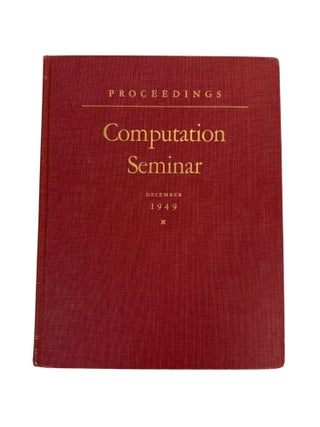
IBM computation proceedings from the December 1949 seminar, recording the emerging methods and applications of high speed computation as mathematicians, scientists, and IBM engineers worked across electronic calculation, punched card machinery, numerical analysis, Monte Carlo methods, and statistical computation. Held at IBM’s Department of Education in Endicott, New York, from December 5 to 9, 1949, the seminar brought together research engineers and scientists working on mathematical methods for physical problems and their implementation on computing machinery. Its contributors include John von Neumann, Richard W. Hamming, Mark Kac, M. D. Donsker, and John W. Tukey, with von Neumann opening the technical proceedings with “The Future of High-Speed Computing.” The volume captures a period when electronic computation had begun to move beyond experimental machine building toward the formulation of methods, problems, and professional practices that would define scientific computing during the following decade.Hurd, Cuthbert C., ed. Proceedings, Computation Seminar, December 1949. New York: International Business Machines Corporation, 1951. First edition. Edited by the IBM Applied Science Department, Cuthbert C. Hurd, Director. The contents range from von Neumann’s “The Future of High-Speed Computing” and Hamming’s “Some Methods of Solving Hyperbolic and Parabolic Partial Differential Equations” through matrix methods, rational approximation, construction and interpolation of tables, Monte Carlo computation, stochastic methods in quantum mechanics, and Tukey’s “Standard Methods of Analyzing Data.” Several papers document the direct application of IBM machinery to mathematical work, including John P. Kelly’s “Matrix Multiplication on the IBM Card-Programmed Electronic Calculator,” John Lowe’s “Solution of Simultaneous Linear Algebraic Equations Using the IBM Type 604 Electronic Calculating Punch,” Everett Kimball, Jr.’s “Table Interpolation Employing the IBM Type 604 Electronic Calculating Punch,” and P. C. Johnson and F. C. Uffelman’s “A Punched Card Application of the Monte Carlo Method.” The front pastedown bears the bookplate of “The Owen E. Rogers Reference Library,” contributed by his wife Mary Evelyn, while the facing endpaper is stamped “National Psychological Training School of Natural Healing / 13 South ‘J’ Street / Pensacola, Florida.”
The seminar belongs to IBM’s concentrated program of scientific computation meetings around 1948 to 1951, during the years in which punched card equipment, electronic calculating units, and stored program computers overlapped as working technologies. The December 1949 proceedings are particularly revealing of that overlap: theoretical papers on differential equations, matrix problems, probability, and statistics appear beside accounts specifying how those problems could actually be processed by IBM equipment. The Monte Carlo section alone includes Kac and Donsker’s “The Monte Carlo Method and Its Applications,” Johnson and Uffelman’s punched card implementation, Yowell’s application to Laplace’s equation, and Gilbert W. King’s work on stochastic methods in quantum mechanics. Published in 1951, the volume is recorded by the Smithsonian’s National Museum of American History among a series of IBM computation seminar proceedings and is bibliographically described at 173 pages; contemporary bibliographic records likewise identify the 1951 IBM publication of Hamming’s contribution on pages 14 through 23. 173 pages, illustrated with mathematical diagrams, graphs, tables, and technical figures; original burgundy cloth lettered in gilt; quarto. Light rubbing and soiling to cloth, with wear at corners and extremities; contents clean and well preserved; institutional and reference library markings to front endpapers. Overall very good condition. A record of the moment when high speed computation became a working scientific discipline, joining von Neumann’s conception of the field’s future to the numerical methods and IBM machine applications through which that future was being put into practice.
Item #23880
Price: $3,800.00
See all items in New York, Early Computing, Technology, Engineering & Innovation
See all items in American History by State, Science, Medicine & Technology
See all items in New York
Suggested Early ComputingBrowse All




Suggested New YorkBrowse All




Suggested American History by StateBrowse All