Clearwater, Florida Crime, Automobile Accident & Police Photo Archive: Life, Death & Emergency Response in the Postwar Sunbelt Boom, 1950–1953
Photograph
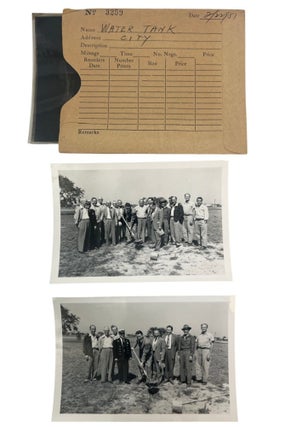
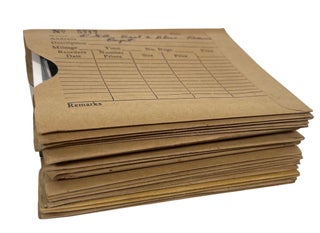
Crime, accidents, and police involvement photo archive, 1950 to 1953, documenting the physical consequences of automobile dependence and the work of police and emergency services during Clearwater and Pinellas County’s extraordinary postwar expansion. Pinellas County grew from 159,249 residents in 1950 to 374,665 in 1960, an increase of more than 135 percent, as automobiles, new roads, commercial corridors, and suburban development transformed the peninsula. Fulmer photographed wrecks, police investigations, criminal incidents, incarceration, and emergency response within this changing environment, including officers measuring collision scenes and documenting vehicles after impact. The archive records the less celebrated infrastructure of the Florida boom: the accidents, investigations, damaged property, arrests, and sudden deaths that accompanied a rapidly motorizing Sunbelt community.Photo archive of 106 photographic items total, including 53 silver gelatin photographs and 53 corresponding negatives, contained in 15 original George Fulmer studio envelopes with manuscript assignment captions, Clearwater, Florida, 1950 to 1953. Silver gelatin photograph prints ranging from 4.5 x 2.5 to 5 x 4 inches, and each negative about 4 x 5 inches. Automobile accidents form the largest and most detailed component. Fulmer photographed severely damaged sedans at roadsides and repair facilities; automobiles with crushed front ends, buckled doors, shattered windshields, and displaced body panels; police officers measuring a collision scene while residents watch from both sides of the roadway; and a motor scooter lying beside the road following an accident identified on its envelope, dated July 27, 1951, as “Accident, motor scooter, Gulf to Bay & Chestnut.” Another July 27, 1951 envelope identifies an “Auto wreck, front Table Supply,” while a September 24, 1951 assignment names “Plant, Irene” and “wrecked auto.” A substantial sequence documents an automobile driven into an Eckerdly Door school bus marked “School bus stop on signal,” with Fulmer moving around the vehicles to record the crushed hood, shattered windshield, points of impact, bus signage, police presence, and surrounding traffic. Other assignments show two automobiles after a collision as police measure tire and skid positions across the pavement, and damaged vehicles photographed from several angles after removal from accident scenes. Crime and police work extend the record beyond traffic enforcement. An envelope captioned “Police Dept. open safe” accompanies photographs of an officer examining an overgrown roadside area beside a marker reading “Cleveland,” apparently recording an investigative site; another assignment identified as “Moore Lodge break in” documents a ransacked office, scattered papers and drawers, damaged interior construction, and an opened safe, including close views of the safe and surrounding objects. An envelope dated March 13, 1950 and captioned “Gifford, County Jail” accompanies photographs of an elderly bearded man at the jail, including his departure down the courthouse or jail steps between two men and a presentation before barred cells. Fulmer also photographed a crowded emergency response identified by its studio envelope as “Drowning at beach,” where police and civilians surround a covered body on a wheeled stretcher, and an August 25, 1953 assignment identifying Mrs. Sidney Starr and Bobby as “lightning victim,” showing a boy recovering in bed beside a woman.
These assignments date from the decade in which Pinellas County underwent the most rapid population expansion in its history and local government confronted the practical consequences of a landscape increasingly organized around automobiles. County planning histories identify the 1950s as a period of exceptional demographic growth and road construction, including the opening of the Sunshine Skyway in 1954 and completion of the Gulf Coast Highway, now U.S. 19, in 1955, developments that accelerated roadside commerce and automobile based settlement. His crime assignments apply the same documentary practice to opened safes, disturbed interiors, jail subjects, and sites associated with police investigations. The survival of corresponding negatives, finished silver gelatin prints, and Fulmer’s 15 captioned studio envelopes preserves the working structure of a commercial photographic practice employed to make incidents reproducible and identifiable, while the scenes themselves record the growing demands placed upon police and emergency services by postwar Clearwater. Light handling wear to photographs and negatives, with curling to some. Toning to the original studio envelopes. Overall in good condition.
Item #23824
Price: $850.00
See all items in Natural & Industrial Disasters, Urbanization & City Development, Florida, Police & Law Enforcement, Vernacular & Community Photography
See all items in American History & Americana, American History by State, Law, Incarceration & Public Policy, Photography
See all items in Florida
Suggested FloridaBrowse All




Suggested PhotographyBrowse All


Suggested American History by StateBrowse All