African American Family Photo Archive Spanning World War II and Postwar America, with Rare Black Life on Midway Island and Three Decades of Vernacular Photographs of Family, Courtship, Celebrations, , and Domestic Life, circa 1940s–1970s
Photograph
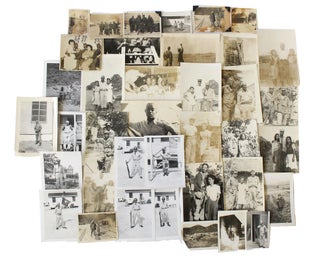
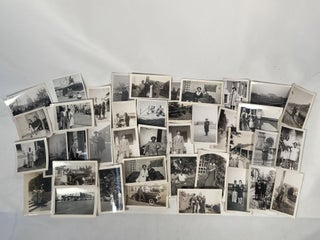
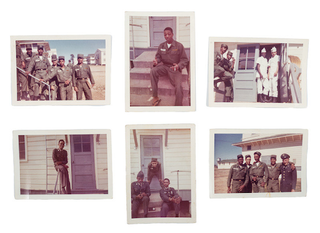
Black family photo archive spanning the 1940s through the 1970s, documenting domestic life, travel, holiday celebration, and family relationships across the World War II and postwar generations. An early group of photographs captioned “Midway Island” and “Gooney birds” places part of the family record at the strategically important Pacific atoll associated with the U.S. military, although the identity and military status of the person responsible for these photographs remain unconfirmed. The later color photographs move into the intimate spaces of postwar Black family life, preserving Christmas gatherings, couples, children, automobiles, cooking, leisure, and informal portraiture over several decades.Photo archive of 22 black and white and color photographs, most approximately 3.25 x 4 inches, unidentified United States locations and Midway Island, circa 1940s to 1970s. Most of the later images are instant photographs, likely Polaroids, while the earlier material includes conventional black and white snapshots. The Midway album page contains nine photographs, including seabirds beneath the handwritten caption “Gooney birds,” a view captioned “Midway Island,” and domestic or barracks interiors showing Black men relaxing and one man standing on crutches with his lower leg in a cast, captioned “On the crubs??” Later photographs show men and women posed beside automobiles, family groups in living rooms, children visiting Santa Claus, a man preparing food in a kitchen, a woman seated among Christmas presents, a large dog posed with family members and wrapped gifts, and men and women in the dress and hairstyles of the 1960s and 1970s. Several images carry handwritten identifications or dates on the versos. One is inscribed “To Loretta / The lady that / I have a sparkle / in my eyes for! / John F. Hunter / ‘77’”; another is dated “Dec. 25 1974”; and another identifies “Winnie and Jessie in a mad mood (Smile).” The photographs range from composed family portraits to casual scenes made inside homes, creating a record shaped by the people pictured rather than by a commercial or institutional photographer.
The Midway photographs connect the family material to a Pacific site transformed by American military expansion and the Battle of Midway of June 1942, when the atoll functioned as a heavily defended naval air station and operating base. Black military service during this period occurred under formal racial segregation. The U.S. Navy had restricted Black enlistment largely to the messman branch before announcing in April 1942 that Black men could enter general service beginning June 1; as late as February 1943, more than two thirds of the Navy’s 26,909 African American sailors remained mess attendants. The photographs do not establish that the Black men pictured at Midway were sailors, soldiers, or wartime personnel, and the Midway material may date later, but its presence within this family group preserves a geographic connection between Black American experience and an island dominated during and after the war by the U.S. military. The later photographs record a different sphere of twentieth century Black experience through vernacular photography: private homes, Christmas rituals, courtship, food preparation, clothing, automobiles, children, and the ordinary social occasions that families chose to photograph and annotate. The inscriptions preserve first names and personal relationships even where full identification has been lost. Light surface wear, occasional creasing, fading, discoloration, and handling wear; several photographs trimmed for mounting and two album leaves with mounted images. Overall in good condition. A multigenerational visual record of Black family life extending from a Pacific military setting associated with World War II into the domestic and social world of postwar America.
Item #23765
Price: $485.00
See all items in African American Family & Community Life, African American Military Service, African American Photography
See all items in African American History, Photography
See all items in Midway Island
Suggested African American Military ServiceBrowse All




Suggested African American PhotographyBrowse All





Suggested African American HistoryBrowse All




Suggested PhotographyBrowse All