Western Pine Logging Operations and Industrial Forest Engineering in the American West, California, Oregon and Arizona, 1920s-40s
Photograph
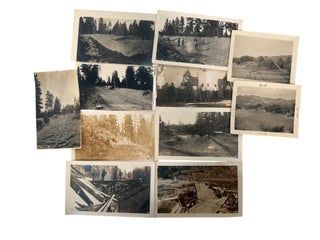
Western logging and resource extraction photo archive, circa 1925 to 1940, documenting the engineering, labor, and transportation systems that supported industrial development across the American West. The photographs record the transformation of forests and mountain landscapes into organized production sites through road construction, surveying, bridge building, temporary camps, and mechanized earthmoving. Their emphasis falls not on harvested timber alone but on the infrastructure that allowed western pine forests and mineral resources to be exploited on an industrial scale during the period when the Western Pine Association promoted standardized forestry practices and expanding commercial lumber production throughout the Pacific Coast states.Photo archive of 11 silver gelatin photographs, approximately 3.5 x 4.5 inches, Northern California, Oregon, and Arizona, circa 1925 to 1940. The photographs show crews grading wide logging roads with early bulldozers and earthmoving equipment; surveyors laying out roadbeds with transits and leveling rods; timber bridges and heavy wooden structures under construction; logging camps with canvas bunkhouses and workers posed outside camp buildings; cultivated fields and company gardens established beside mountain camps; and forest clearings where wagons, equipment, and draft animals remain in use alongside mechanized machinery. Two photographs depict Arizona mining operations and retain contemporary manuscript captions on the versos. One reads, "This is a view of the sluice box before it is quite done, has a large or tall gin pole to be put up above hopper for pulleys to work on." Another identifies a camp and garden, noting, "This is a picture of the camp and garden and in the back ground can see the sluice box in the canyon." Several images appear to have been produced as documentation of western pine logging operations, possibly in connection with the Western Pine Association or a related lumber concern.
The archive belongs to the decades when western timber companies shifted from rail centered logging toward increasingly extensive truck roads, crawler tractors, and mechanized grading, allowing commercial harvesting to penetrate previously inaccessible stands of ponderosa pine and mixed conifer forests in Northern California and Oregon. Founded in 1916, the Western Pine Association encouraged scientific forestry, standardized lumber grading, and modern logging methods as western pine became one of the nation's principal building materials during the interwar years and the approach to the Second World War. The Arizona views complement this narrative by documenting comparable engineering practices in western mining, where sluice boxes, temporary camps, and improvised lifting systems illustrate the labor required before mechanized extraction reached full capacity. Particularly notable is the absence of hard hats and modern protective equipment, reflecting industrial work before federal occupational safety regulations fundamentally altered logging and construction practices after the creation of OSHA in 1970. Light surface wear, occasional corner rubbing, and minor silvering; overall in very good condition. A concentrated visual record of the engineering, labor, and temporary infrastructure that made large scale timber and mineral extraction possible across the early twentieth century American West.
Item #23599
Price: $450.00
See all items in Arizona, Oregon, Environment & Resources, Vernacular & Community Photography
See all items in American History by State, Labor, Environment & Industry, Photography
See all items by Western Pine Logging
Suggested OregonBrowse All





Suggested ArizonaBrowse All





Suggested PhotographyBrowse All




Suggested American History by StateBrowse All