World War I Stereographs of American Mobilization, Segregated Troop Movement, and Wartime Return, 1918-1919
Photograph
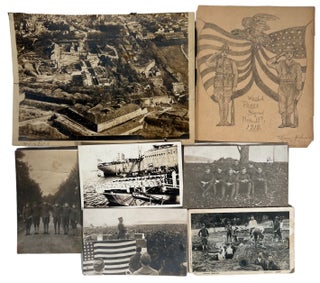
World War I stereographic photographs documenting mass mobilization and wartime public messaging, with scenes of troop training, segregated transport, naval preparation, military medicine, battle damage, and demobilization across the American and European war effort. The photographs preserve the structure of modern war and the language used to justify it, through in captions linking domestic reunion to major campaigns and in racialized commentary on Black troops moving toward embarkation. The archive moves from recruitment and preparation to overseas destruction and return to family life, and preserving the framework through which these scenes were presented to American viewers.Photo archive of 46 silver gelatin stereographic photographs, each approximately 7 x 3 inches, produced in the United States, circa 1918 to 1919, with scenes photographed in both the United States and France. The cards are mounted on gray stock with printed titles, serial numbers, and lengthy descriptive texts on the versos. Visible scenes include the "1918 Graduating Class at Annapolis," linking the group to officer and naval training; "Fighters Who Broke the Hindenburg Line Parading Down Fifth Avenue," showing victory procession in a major American city; and "Troops on March En Route to Camp After Leaving Transport, New York Harbor," where armed servicemen advance through streets lined with civilians waving flags and handkerchiefs while several spectators watch from a rooftop. Other cards show massed formations under the title "Our Answer to the Kaiser, 3,000 of America's Millions Eager to Fight for Democracy," naval recruits standing at parade rest, a church converted into a hospital with rows of wounded men on cots, a disappearing coast defense gun elevated for firing at Fortress Monroe, African American soldiers shown segregated from white units and halted beside railway cars in "Colored Troops Taking Train Rest," and "Shooting German Airplanes, Aircraft Gun Concealed in the Woods," showing two servicemen aiming anti-aircraft artillery skyward. Additional views show soldiers searching shattered ruins in France, peace delegates visiting devastated Arras, embarkation and harbor activity, prisoners under guard, and soldiers reunited with wives and children. The printed verso texts sharpen the wartime framing throughout: the New York Harbor parade card invites viewers to imagine securing "the lofty station on the lamp post" for a better view of the "long, brown line"; "Happy Reunion for Soldier Fathers" connects domestic embrace to Chateau-Thierry, Soissons, St. Mihiel, and the Meuse-Argonne; "Our Answer to the Kaiser" frames troop concentration as a democratic national response to Germany; "Colored Troops Taking Train Rest" preserves both the visibility of Black military movement and the paternal racial language used to describe Black soldiers during the period; and the anti-aircraft gun card identifies the weapon as part of the defense of Paris against air raids.
These stereographs treat World War I as a coordinated military and social system, moving from academy training and troop embarkation to anti-aircraft defense, hospital care, ruined French cities, victory parades, and reunion at home. The group preserves the language that organized public understanding of that system, including patriotic appeals to democracy and openly racialized descriptions of Black troops in transit, making the cards evidence of both wartime experience and wartime instruction. Light general handling wear with minor edge and corner wear; printed titles and verso texts clean and legible. A sustained visual account of how the First World War was mobilized, staged for public viewing, and folded into American memory and national myth-making.
Item #23191
Price: $850.00
See all items in Europe, World War I
See all items in International & Global Culture, Military & War, Archive
See all items by World War I. Mobilization
Suggested World War IBrowse All




Suggested EuropeBrowse All




Suggested ArchiveBrowse All