Women's Incorporation into Military Service Photo Archive, 1940s
Photograph
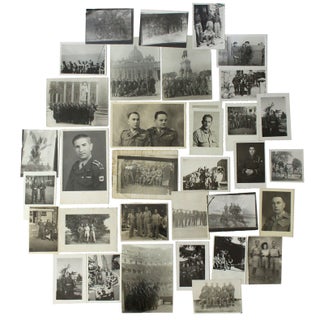
[Women's History][Military] Women’s military service photo archive documenting the incorporation of women into military organizations in the United States Russia and Europe from the ear;y 40s through the end of World War II, with especially strong evidence of uniformed training, rank identity, weapons instruction, and military parades in the 1940s. The group shows women as enlisted or commissioned participants in military systems in portrait sittings, unit groupings, drill, formal dress, and liberation era parade culture. Several images center on Czechoslovak and Soviet aligned visual culture at the end of the war, including a Prague parade photograph explicitly identifying women volunteers attached to the 1st Czechoslovak Army on 17 May 1945, placing female service on the public stage of postwar victory.Photo archive of 14 likely silver gelatin photographs, ranging from 1.5 x 2 to 3 x 5.5 inches, United States and Europe, circa 1910s-1945. The archive includes formal studio portraits of individual women in military tunics with shoulder boards, insignia, peaked caps, and medals; a close portrait of a decorated woman officer wearing a sash and multiple campaign medals; and a full length image of a young servicewoman holding a rifle on what appears to be a stage or drill platform. Group scenes include seven women in matching belted uniforms and caps posed outdoors near a long low building (captioned 1944), three women in service dress photographed among trees, and two women in white formal or naval style uniforms standing in a landscaped garden. A small early portrait shows a younger female figure in uniform beside an older woman, extending the chronology back before the Second World War. The Prague parade image is the most textually grounded item: its printed Czech caption states that the military review of the 1st Czechoslovak Army was held in Old Town Square on 17 May 1945 in the presence of President Edvard Beneš and identifies the marching contingent as women volunteers assigned to that army. Recurring themes across the collection include rank display, military insignia, paired and group portraits emphasizing unit identity, and the shift from informal military support to organized involvement and state recognition.
Across the first half of the twentieth century, women entered military institutions through auxiliary organizations, medical and communications branches, transport and administrative service, anti aircraft and weapons training, and in some national contexts direct incorporation into regular formations. This archive tracks that process through its own evidence: portraiture records accession into uniformed hierarchy, group photographs show women organized in units, the rifle image places female service within martial training rather than clerical abstraction, and the Prague review demonstrates how women’s wartime labor and service were folded into liberation politics and postwar state ceremony. The international span gives the group unusual strength for institutional collecting on women’s military history because it places American and European service culture in one frame and shows the common mechanisms by which states made women visible, disciplined, and legible within military life between the two world wars and at the end of the second. Light to moderate wear, scattered creasing, edge wear, handling marks, and some fading or softness to several prints; overall good condition. This is a compact but pointed body of photographic evidence for how women were absorbed into military systems through uniform, training, ceremony, and public recognition across the WWI-WWII era.
Item #23185
Price: $550.00
See all items in World War II, Military & War Photography, Women & the Military, Other (Women's History), Russia/USSR
See all items in Military & War, Photography, Women’s History & Feminism, World History by Geography
See all items by Women in Military
Suggested World War IIBrowse All






Suggested Russia/USSRBrowse All




Suggested PhotographyBrowse All


Suggested World History by GeographyBrowse All