Japanese-American College Girl's Life "Reiko" in Oʻahu , Hawaii in the Years Directly Following WWII Photo Album, 1946-50s
Photograph
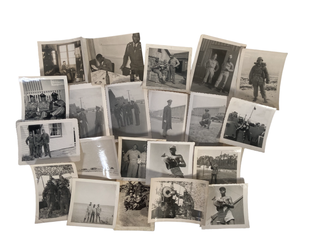
[Japanese-American] [Women's Education] Postwar Hawaiʻi identified Japanese-American university school girl's photo album. Oʻahu Territory of Hawaiʻi, 1946–1950, spanning the years right after World War II. Approximately 260 silver gelatin photographs documenting the daily life, friendships, education, and civic participation of a Japanese American young woman living on Oʻahu in the immediate postwar period. The photographs are mounted in a 9" x 11" woven album with photos cornered in on black board pages. Images range from small snapshot-format prints to larger horizontal photographs. Following Pearl Harbor, Hawaii was initially considered a war zone, and the Japanese Americans there were subject to heavy surveillance and civil rights violations until the war ended in 1945. This album ranges 1946 to circa 1950, with one loose photograph predating the album by approximately a decade, likely depicting the compiler as a child. The compiler is identified by name in captions as Reiko who also went by “Rei”, Reiko was a Japanese American college student and Pre-Med Club member residing on Oʻahu.This substantial and unusually well-captioned album offers a deeply personal record of Japanese American civilian life in Hawaiʻi following the end of World War II and the lifting of martial law. The first third of the album features extensive handwritten captions, frequently identifying individuals, locations, and events, while the latter portion contains fewer annotations but continues the visual narrative of family, friendship, and place. Reiko’s life is documented across academic, social, and community spheres depicting college friendships, Pre-Med Club activities, leisure outings, and participation in Laulima, a Hawaiian community support organization emphasizing mutual aid and collective responsibility. Numerous images record friendships among young women posed confidently in dresses, skirts, slacks, and swimsuits, as well as traditional Japanese dress and Hawaiian dress and leis, showcasing cross-cultural identity. Family life appears alongside repeated photographs of Lorraine Nakamuta, age 2½, likely a relative, shown in candid domestic and outdoor scenes, some in western attire, and a few photos playfully dancing in a straw hula skirt. The album also serves as a visual geographic survey of mid-century Hawaiʻi, with identified sites including Halemaʻumaʻu Crater, sugar cane fields, irrigation infrastructure such as a wooden pipe transporting water, Robert Louis Stevenson’s hut, beaches, valleys, and residential neighborhoods.
Public and civic life figure prominently. Several sequences document an Hawaiian beauty pageant, as well as floats, marching bands, and crowds celebrating the Philippine Islands Independence Day Parade, July 4, 1946, Honolulu, situating Japanese American life within Hawaiʻi’s broader multiethnic and postcolonial Pacific context. These images underscore the reemergence of public celebration and civic participation after wartime restriction, while highlighting interethnic solidarity and shared urban space. Taken together, the album constitutes a rare, large-scale vernacular record of Japanese American womanhood, education, and community engagement during the transitional years between World War II and Hawaiʻi’s statehood era. The album remains intact and structurally sound, with thick board pages and photographs securely attached using original corner mounts. A few photos loose. Minor age-related wear is present, including light scuffing to covers. Handwritten captions remain largely legible throughout. Overall very good condition. This album is an exceptional primary-source document for institutional collections, offering sustained visual evidence of Japanese American youth culture, women’s education in the sciences, and everyday resilience in postwar Hawaiʻi, enriched by named individuals, identified locations, and detailed contemporaneous annotations.
Item #23068
Price: $1,200.00
See all items in Hawaii, Japanese American Family & Community Life
See all items in American History by State, Asian American History, Women’s History & Feminism, Archive
See all items by Japanese-American in Hawaii
See all items in Hawaii
Suggested HawaiiBrowse All


Suggested Asian American HistoryBrowse All



Suggested ArchiveBrowse All





Suggested American History by StateBrowse All