Panama Canal and Caribbean Trade History: Photographic Views of Panama City, Canal Infrastructure, and Urban Life, 1920s
Photograph
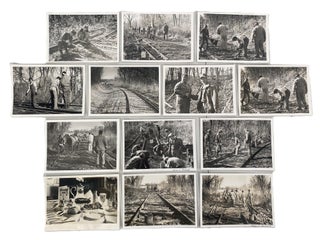
Panama City photograph archive, ca. 1920s, documenting the urban environment of the Panamanian capital and the infrastructure of the Panama Canal during the decades following the canal’s opening in 1914. The photographs record the interconnected worlds of canal engineering, international commerce, tourism, and everyday street life that developed as Panama City became a strategic hub of global shipping and American geopolitical influence in the Caribbean basin. Urban scenes depict commercial storefronts, streetcars, automobiles, and pedestrian activity along central avenues, while other photographs capture the canal’s mechanical landscape of locks, spillways, and industrial structures. Together the images illustrate the transformation of Panama City into a cosmopolitan port city shaped by canal traffic, international trade, and the presence of the U.S. Canal Zone administration.Archive of eighteen original silver gelatin photographs depicting Panama City and surrounding canal infrastructure. Each measure approximately 3.5 x 5.5 inches. Several images show major canal engineering features including a photograph captioned “Purifying Plant and Spillway – Panama Canal,” as well as views of lock systems and canal transport routes where cargo vessels pass through the waterway. Urban photographs record commercial and entertainment districts, including a façade marked “American Cabaret,” a busy street labeled “Street Scene – Panama City,” and a view of the Hotel Central along a principal thoroughfare lined with automobiles and electric streetcars. One photograph bears the caption “264 – President’s Palace on day of Riot Panama 2-28-…,” showing crowds gathered along balconies and streets near the presidential residence during a moment of public unrest. Additional photographs document daily life and local commerce including outdoor market scenes, pedestrians and vendors, workers posing near canal machinery, and residents standing beside storefront displays. Landscapes and travel images appear as well, including a waterfall and rural roadside scenes with automobiles, indicating the expansion of modern transportation and tourism into the Panamanian countryside during the early twentieth century.
The photographs collectively capture the layered social and industrial landscape that emerged in Panama after the completion of the Panama Canal, when the city became a focal point of hemispheric trade and international transit. The canal drastically shortened maritime routes between the Atlantic and Pacific Oceans and reshaped the economy of the Caribbean and Pacific coasts of the Americas. Panama City consequently developed a complex urban culture combining local Panamanian communities, canal workers, foreign merchants, travelers, and U.S. officials connected to canal administration. Light surface wear and minor edge handling visible on several prints, overall very good condition. These images document that environment through views of transportation infrastructure, entertainment venues, commercial streets, and civic spaces, offering a visual record of Panama City during the formative decades of the canal era. Photographs measure approximately postcard size.
Item #23043
Price: $880.00
See all items in Industrialization, Manufacturing, and Infrastructure, Imperialism & Colonialism, Travel & Cultural Photography, Technology, Engineering & Innovation, Mexico, South & Central America
See all items in Labor, Environment & Industry, Military & War, Photography, Science, Medicine & Technology, World History by Geography
See all items by Panama Canal Infrastructure Urban Life
See all items in Panama
Suggested Industrialization, Manufacturing, and InfrastructureBrowse All




Suggested PhotographyBrowse All



Suggested World History by GeographyBrowse All