J.D. Salinger Exceptional Typed Letter Signed on His Personal Beliefs of Truth, Friendship, and Discussing the Boarding School That Inspired Catcher in the Rye" "I went to an awful, fourth-class boarding school… it couldn’t have been worse, but it was full of misfits, kids that didn’t fit in "
Manuscripts & Autographs
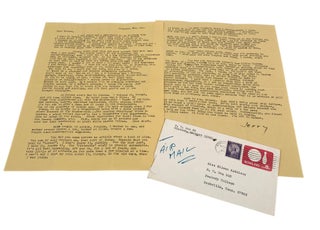
[Literature] Salinger, J.D. American author of Catcher in the Rye. Typed letter signed from Salinger to his friend Eileen Paddison. January 25, 1972. One page, typed on Salinger’s characteristic goldenrod paper, signed boldly in ink at the foot: “Love to you, Eileen — Jerry.” A letter chronicling friendship between Salinger and Paddison, in which Salinger relates to their "sameness", and provides personal insight on subjectivity and "truth". Salinger would characterize the relationship between himself and Eileen in 1975 as one between "a brother or sister, or some kind of close blood relative anyway", one born of warmth and mentorship which mirrored the sibling bond of Holden and Phoebe Caulfield and Franny and Zooey Glass. A deeply personal letter from J.D. Salinger to Eileen Paddison, written just weeks after their correspondence began in late 1971. At this point Paddison was a young college student and aspiring writer who had approached Salinger about Zen, Taoism, and the spiritual questions embedded in Franny and Zooey, themes that had become central to his private life. This January 1972 letter is one of the earliest to survive from their remarkable epistolary friendship. Exceptionally, Salinger closes this letter with “Love to you,” a warmth he very rarely expressed in writing and almost never in letters to non-family. Its presence here, so soon after their acquaintance, testifies to the immediate and unusual closeness he felt toward Paddison.The letter features Salinger’s characteristic blend of humor, candor, private philosophy, and autobiographical detail. Reflecting on the “sameness” between himself and Eileen, a theme that would only deepen over their years of correspondence, he writes: “Oh, God, life is full of some pretty funny stuff off and on… And there are moments, I have a notion, when there are echoes of sameness between us, maybe having to do with our matching awkward ‘background’… Who do little kids who are self-described "best friends" do?...a form of narcissism, in a real sense, but more complicated than that.” He discusses Taoist and Zen inflections in his thinking through an anthropological lens, mentioning beauty standards in other nations, he questions "Is there any possibility of "truth" in this world when vantage points and reasoning powers depend so heavily on conditioning, heredity, culture, language, geography, etc.? Almost none.” The sense of epistemological skepticism, of truth mediated through perception, echoes the teachings of Taoist thinkers such as Chuang-tzu, whose relativistic parables informed Salinger’s later spiritual worldview.
Salinger’s reflections on academia in this January 1972 letter reveal how quickly he perceived in Eileen Paddison a biographical and emotional mirror, grounded in their shared experience of feeling like outliers within educational institutions rather than beneficiaries of them, and this recognition is inseparable from the imaginative terrain of The Catcher in the Rye. His recollection—“I went to an awful, fourth-class boarding school… it couldn’t have been worse, but it was full of misfits, kids that didn’t fit in anywhere”—closely parallels Holden Caulfield’s scathing assessments of Pencey Prep, where hypocrisy, cruelty, and emotional vacancy define the school environment and leave Holden drifting between expulsion and psychic collapse. Salinger’s own progression from a series of unhappy boarding schools to the Valley Forge Military Academy, with its emphasis on regimentation, surveillance, and obedience, provided the experiential core for Holden’s alienation: the sense that schools function less as places of moral development than as systems designed to enforce conformity and punish sensitivity. In the letter, Salinger’s observation that “If one's going to be away at school or in prison or in the Army, it's only fair that a few congenial types be around” echoes Holden’s repeated longing for authentic human connection amid institutional emptiness—whether in his attachment to Phoebe, his idealization of Jane Gallagher, or his fleeting, fragile encounters with classmates who momentarily seem “all right.” By aligning schooling with prison and military service, Salinger articulates the same critique that animates Catcher: that adolescence is uniquely vulnerable to institutional damage, and that survival depends on the presence of a single trustworthy companion who can affirm one’s interior life. In recognizing this shared outsiderhood in Paddison, Salinger was not merely reminiscing but reinhabiting the emotional logic that produced Holden Caulfield, revisiting his own boarding-school dislocation as a source of empathy rather than bitterness, and using it to justify the sudden intensity of a bond formed late in life during a period of increasing reclusion, when personal connection—like Holden’s imagined role as a “catcher in the rye”—had come to feel morally urgent and protective. This letter shows him revisiting the terrain of his own boarding-school dislocation as a point of affinity, a shared outsiderhood that resonated deeply during a period of his life when he was increasingly reclusive and invested in nurturing private, carefully chosen connections.
Salinger lastly touches on his family life, offering early glimpses of a subject he seldom addressed. He briefly mentions his daughter Peggy in passing, whose relationship with him would become increasingly strained and ultimately estranged, and his son Matthew of whom he was close with, and signs off with his fond memories of visiting a hotel in Lake Placid with him every autumn. These early glimpses of his private domestic world, alluded to so soon after meeting Paddison, are unusually revealing for a writer who had withdrawn almost entirely from public life by the 1970s. A rich, early, and unusually intimate letter in the Salinger–Paddison correspondence, written precisely at the moment their relationship was forming. Its mix of humor, Taoist reflection, autobiographical revelation, and the extremely rare closing “Love to you” make it one of the more emotionally expressive Salinger letters to appear on the market, documenting the emergence of one of the most meaningful friendships of his later life. Scarce and in very good condition.
Item #22918
Price: $14,700.00
See all items in Author Autograph & Manuscripts, Literature
See all items in Literature & Literary Archives, Exceptional Pieces , Autographs, Manuscripts & Letters
See all items by J D. Salinger
Suggested LiteratureBrowse All



Suggested Exceptional PiecesBrowse All