Latin American Mining Labor and U.S. Economic Imperialism: Rosario Gold Mine Photograph Archive, Honduras, Circa 1910s–1920s
Photograph
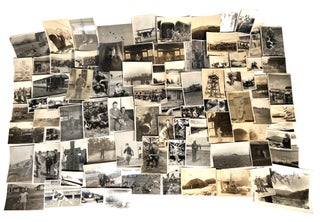
Rosario Gold Mine photograph archive documenting industrial labor, mining infrastructure, and community life in Honduras during the early twentieth century, produced circa 1910s–1920s. The images record activity surrounding the Rosario Gold Mine near Tegucigalpa, one of the most important foreign-operated mining enterprises in Central America during the late nineteenth and early twentieth centuries. Several photographs bear verso annotations identifying the site as “Rosario Gold Mine, Honduras,” with one dated December 22, 1928 and others attributed to photographer J.M. Banegas of Tegucigalpa. The photographs document mining operations, workers, and surrounding settlements at a time when the New York and Honduras Rosario Mining Company controlled one of the region’s most productive gold and silver operations. The archive provides visual evidence of extractive industry, local labor systems, and the social environments that developed around foreign-owned mining ventures in Honduras during a period of expanding U.S. and British commercial influence in Central America.Archive of 28 original silver gelatin photographs taken in the mining districts surrounding Rosario, San Juancito, and Santa Domingo near Tegucigalpa, Honduras. The images depict steep hillside mine shafts, ore processing facilities, and workers posed with tools or beasts of burden across rugged terrain characteristic of the Honduran highlands. Several photographs show miners hauling ore or operating machinery, while others document groups of laborers dressed in work clothing and wide-brimmed hats typical of early twentieth century mining communities. Domestic scenes include women baking bread at outdoor ovens identified in one verso caption as “Baking Bread—Santa Domingo,” along with children and families gathered outside wood-plank houses. Additional photographs depict residential verandas and administrative buildings likely associated with company officials or expatriate personnel, illustrating the social divisions that accompanied foreign industrial operations. Verso inscriptions identify locations and subjects, and some prints credit J.M. Banegas of Tegucigalpa as photographer. 28 photographs. Silver gelatin prints on a mixture of photographic and postcard paper stock. Photographs measure approximately 3 x 5 inches to 4 x 6 inches. The images collectively document industrial infrastructure, labor organization, and daily life within mining settlements that developed around the Rosario Gold Mine following its establishment in the 1880s by the New York and Honduras Rosario Mining Company. These operations became a major source of gold and silver production in Central America and served as an early example of foreign corporate involvement in the region’s extractive industries. Light surface wear and mild age toning across several prints, with occasional creased corners and handling marks. Images retain strong tonal contrast and clear detail. Overall very good condition. A cohesive visual archive documenting mining labor, industrial infrastructure, and community life within one of the most historically significant foreign mining enterprises in early twentieth century Honduras.
Item #22694
Price: $1,750.00
See all items in Labor & Labor Movements, Travel & Cultural Photography, Mexico, South & Central America
See all items in Labor, Environment & Industry, Photography, World History by Geography, Archive
See all items by South American Mining
See all items in Honduras
Suggested PhotographyBrowse All


Suggested ArchiveBrowse All






Suggested World History by GeographyBrowse All