Meiji Era Japan in Stereoscopic Photography Underwood & Underwood Views of Religion, Labor, and Urban Life, circa 1900s
Photograph
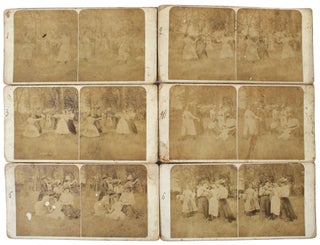
Underwood & Underwood stereoview archive documents Japanese religious practice, labor systems, and urban environments during the Meiji period, when Japan underwent rapid industrialization and imperial expansion following the First Sino-Japanese War and the Russo-Japanese War. Produced in the early 1900s, these images were designed for Western educational and commercial audiences, forming part of a stereographic program that presented Japan as both modernizing and culturally distinct. The archive spans multiple regions including Osaka, Harima, Kyoto, Tokyo, Kawasaki, Mount Fuji, Nikko, and Omori, offering a geographically broad record of religious institutions, agricultural labor, and urban infrastructure. It supports research in early photography, transnational visual culture, and the representation of East Asia in Western media.Collection of 19 black-and-white stereoviews by Underwood & Underwood, albumen prints mounted on original gray card stock with printed captions along the margins and extended descriptive text on the verso. Each stereoview measures approximately 3.5 x 7 inches. The series includes pilgrims ascending the slopes of Mount Fuji in ceremonial dress, and an interior view of monks assembled at Ikegami Temple in Omori surrounded by ritual objects. Views of Nikko depict cedar-lined approaches, shrine architecture, and visitors gathered at temple precincts. Urban scenes include Osaka waterways with merchant boats and a view of Osaka Castle’s stone fortifications and moat. Additional images show a weaver at work, groups of women in kimono posed for the camera, vendors and performers near Kyoto shrines, and children assembled in public activity. Religious imagery includes Shinto elements such as shrine statuary, torii gates, and ritual spaces, alongside landscapes featuring Mount Fuji and coastal environments. The selection reflects a deliberate balance of sacred, rural, and urban subjects.
These stereoviews circulated during a period of expanding international engagement, as Japan promoted itself to foreign audiences while consolidating its status as a modern imperial state. Visual materials of this kind contributed to a transpacific exchange in which Japan was framed through dual narratives of continuity and transformation, aligning with Western expectations of cultural difference while documenting infrastructural and social change. Increasing contact between Japan and the United States during this period combined commercial exchange and tourism with emerging political tensions that would shape immigration and foreign policy debates. Light edge wear and occasional fading primarily to printed text; images remain clear; overall very good condition. A cohesive stereographic archive illustrating the construction and circulation of Japanese visual identity in the early 20th century.
Item #22642
Price: $750.00
See all items in Early Photography, Japan
See all items in Photography, World History by Geography, Archive
See all items by Meiji eras Japan
See all items in Japan
Suggested Early PhotographyBrowse All


Suggested JapanBrowse All





Suggested PhotographyBrowse All






Suggested ArchiveBrowse All