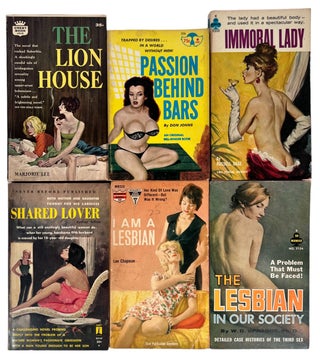
Postwar Sexuality and Censorship in American Lesbian Pulp Novels, Beacon, Domino, and Lancer Imprints, 1959–1965
Collection
Mid-20th century American lesbian pulp novel archive documents the circulation of same-sex female desire within commercial paperback publishing during the late 1950s and mid-1960s, a period defined by legal censorship, psychiatric classification of homosexuality, and expanding underground readerships. Issued between 1959 and 1965, these titles trace narrative patterns through which lesbian identity was introduced to mass audiences, often mediated through sensational marketing and moralized plot structures. The archive includes works by Lesley Evans (pseudonym of Lawrence Block), Kay Addams (pseudonym of Orrie Hitt), Arthur Adlon, and Rea Michaels, whose presence as a female author marks a notable point within a field largely dominated by male writers employing pseudonyms. These works support research in LGBTQ print culture, Cold War social regulation, and gendered authorship in mid-century American literature.Evans, Lesley (Lawrence Block). Strange Are the Ways of Love. New York: Fawcett Publications, 1959. Addams, Kay (Orrie Hitt). Three Strange Women. New York: Beacon Books, 1960. First edition mass-market paperback. Adlon, Arthur. Lesbos Is For Lonnie. New York: Beacon-Signal Books, 1963. First edition. Adlon, Arthur. Too Good For Men. New York: Domino Books, 1965. First edition, noted as previously unpublished. Michaels, Rea. The Needs We Share. New York: Lancer Books, Inc., 1965. Five volumes, each approximately 143 to 154 pages, standard mass-market format. Illustrated covers employ established pulp iconography, frequently depicting pairs of women in intimate or suggestive poses, accompanied by taglines emphasizing transgression, secrecy, and emotional conflict. Narrative structures include urban migration and sexual exploration, interpersonal relationships among women in social or professional settings, and depictions of marital departure in favor of same-sex partnerships. Lesbos Is For Lonnie is notable for presenting a comparatively sympathetic treatment of lesbian identity, explicitly addressing contemporary discourse surrounding “the third sex.”
These works emerged within a regulatory environment shaped by obscenity enforcement and the enduring influence of the Comstock Laws, which constrained overt depictions of sexuality while allowing coded or cautionary narratives to circulate widely. Lesbian pulp fiction functioned simultaneously as exploitative commercial product and as a rare accessible medium through which readers encountered representations of same-sex desire prior to the transformations associated with the Stonewall Riots. The inclusion of Rea Michaels underscores the role of women authors in shaping more interior and experiential narratives within the genre, complicating assumptions about authorship and audience. Light wear and occasional creasing consistent with age; overall very good condition. A representative grouping illustrating the intersection of sexuality, censorship, and authorship in mid-century American mass-market publishing.
Item #22471
Price: $885.00
See all items in Lesbian Literature & Pulp
See all items in LGBTQ+ History, Archive
See all items by Early Lesbian Pulp Novels
Suggested LGBTQ+ HistoryBrowse All




Suggested ArchiveBrowse All