NASA Spaceflight Research Lunar and Orbital Guidance Archive: Rocket Interferometer measurement, Lunar Landing Course correction, Static Stability of Ballistic Bodies, Reentry Plasma Properties About Manned Orbital Spacecraft, 1965–1967
Archive
NASA technical research publications documenting key aerospace engineering studies conducted during the development of the Apollo program in the mid 1960s. The reports address rocket tracking systems, lunar landing guidance algorithms, aerodynamic stability during hypersonic flight, and plasma conditions affecting spacecraft communications during atmospheric reentry. Produced by research teams at Goddard Space Flight Center, Marshall Space Flight Center, and Langley Research Center, the documents illustrate the interdisciplinary scientific work required to achieve human spaceflight and lunar exploration.Archive of four NASA Technical Notes produced between 1965 and 1967 accompanied by four Apollo 14 commemorative sheets issued by the Space Stamp Collectors Society in Jerusalem. The reports include:
[1] The Rocket Interferometer Tracking (RIT) System (NASA TN D-2682, March 1965), authored by Michael Spafford, Richard Wiack, and Ronald Woodman of Goddard Space Flight Center, discusses the development of high-precision tracking systems for rockets and satellites using interferometry. Unlike traditional radar or automatic tracking antennas, the RIT system used "a real-time measurement technique" that derived "the phase difference of signals arriving at two pairs of antennas," allowing for accurate angular position tracking of sounding rockets. The authors state, "the ambiguity of the interferometer data is resolved by rocket velocity... keeping track of correct interferometer lobe," a key breakthrough for mid-1960s telemetry and trajectory analysis.
[2] An Iterative Guidance Scheme and Its Application to Lunar Landing (NASA TN D-2869, July 1965), authored by Helmut J. Horn, Daniel T. Martin, and Doris C. Chandler of Marshall Space Flight Center, presents a guidance model to enable "vehicle flight from lunar orbit to a prescribed point on a spherical, non-rotating moon." Unlike fully adaptive systems, the model uses "a limited number of presettings, the closeness to optimization, the closed form solution, and the ‘homing’ feature,” thus allowing for mid-course correction without real-time computing. Such guidance work directly anticipated the descent phase of the Apollo Lunar Module, making this a critical document in the transition from theoretical models to executable moon-landing protocols.
[3] Some Effects of Jet Pluming on the Static Stability of Ballistic Bodies at a Mach Number of 6.00 (NASA TN D-3698, November 1966) by Robert J. McGhee of Langley Research Center, investigates the impact of engine exhaust on aerodynamic stability. Conducted in a hypersonic wind tunnel, the tests examined shock-induced separation and control loss, concluding that jet-plume interactions caused “significant decreases in both normal-force coefficients and stability derivatives.” Such findings were crucial for designing both reentry vehicles and launch configurations, where thrust-induced instability could jeopardize control.
[4] Deduction of Reentry Plasma Properties About Manned Orbital Spacecraft from Radio Signal Attenuation Data (NASA TN D-4118, August 1967), by Paul W. Huber, also of Langley, compares Mercury and Gemini data with theoretical plasma models. The paper attributes the electron concentration drop during reentry to “ablation impurities in the near-wake viscous flow regions.” Huber’s model explains signal blackout during reentry—a major concern in the Mercury, Gemini, and Apollo missions—and suggests mitigation strategies by manipulating boundary layer chemistry.
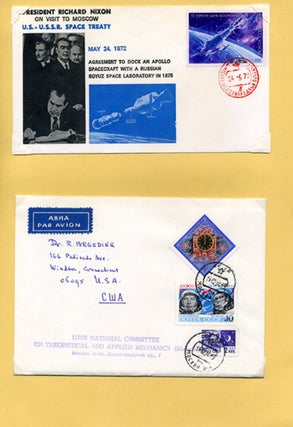
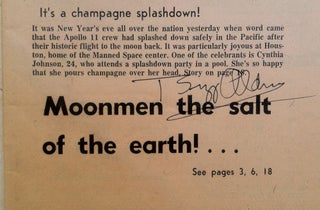
Accompanying the 4 reports are also four printed Apollo 14 ephemera sheets issued by the Space Stamp Collectors Society, Jerusalem. Archive condition is very good, light creasing and faint wear to corners; minor toning to edges; some Hebrew printed library labels at top margins of each report cover, not affecting legibility.
Item #22415
Price: $4,500.00
See all items in Space Exploration & NASA Programs
See all items in Science, Medicine & Technology, Space & Aviation, Archive
See all items by NASA Space Program
Suggested Space Exploration & NASA ProgramsBrowse All





Suggested Space & AviationBrowse All



Suggested Science, Medicine & TechnologyBrowse All



Suggested ArchiveBrowse All