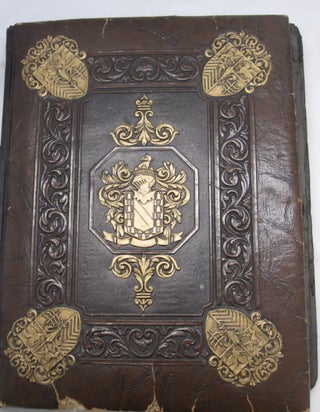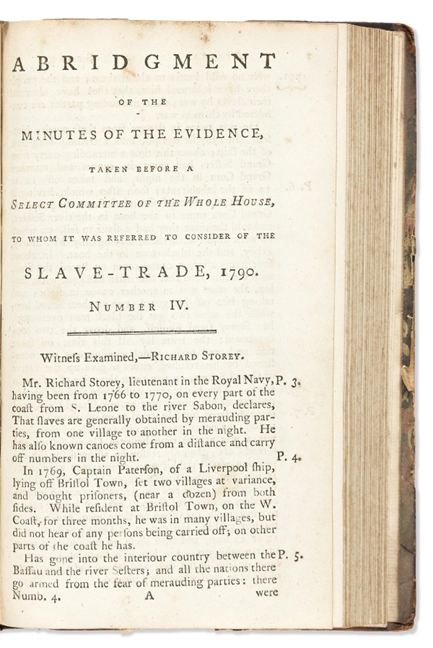
Slavery and Abolition British Parliamentary Investigation of the Atlantic Slave Trade Abridgment of the Minutes of Evidence, 1789 - 1791
First Edition
Committee of the Whole House of the British Parliament investigation into the Atlantic slave trade recorded in Abridgment of the Minutes of the Evidence Taken Before a Committee of the Whole House to Whom It Was Referred to Consider of the Slave Trade, published 1789 to 1791, presenting one of the earliest parliamentary documentary compilations addressing the operation and human consequences of the transatlantic slave trade. The volumes preserve testimony gathered during parliamentary inquiries that examined the practices of British slave traders and the treatment of enslaved Africans transported across the Atlantic. These proceedings formed part of the political campaign in Britain that eventually culminated in the abolition of the British slave trade in 1807. The collected evidence includes statements from ship surgeons, naval officers, merchants, and other witnesses whose accounts describe the conditions experienced by enslaved Africans during capture, transport, and plantation labor.Abridgment of the Minutes of the Evidence Taken Before a Committee of the Whole House, To Whom It Was Referred to Consider of the Slave Trade. London: 1789–1791. First edition, first printing. Four volumes bound in two books. The compilation reproduces testimony presented before Parliament concerning the organization and operation of the slave trade and includes firsthand statements describing the physical suffering and resistance of enslaved Africans during transport. Surgeon Alexander Falcon-Bridge, who had firsthand experience aboard slave ships, described acts of despair among captives: he “Has known several [enslaved persons to] refuse sustenance with a design to starve themselves… refusing to take medicines when sick, because they wished to die… Many other slaves expressed the same.” Another witness, Royal Navy surgeon Thomas Trotter, recorded the emotional trauma experienced by captives during embarkation, noting that “Slaves, on being brought on board, showed signs of extreme distress and despair, from a feeling of their situation, and regret at being torn from friends and connections.” The volumes therefore preserve testimony that exposed the violence and human suffering embedded within the Atlantic slave trading system.
During the eighteenth century European and American traders transported millions of Africans across the Atlantic through a commercial system that relied on maritime networks linking West Africa, the Caribbean, and the Americas. Parliamentary investigations of the slave trade in the late eighteenth century were fueled in part by abolitionist activism and public campaigns demanding government inquiry into the practice. Publications of witness testimony such as this abridged parliamentary record circulated evidence used by reformers advocating the end of the trade. Four volumes bound in two books with folding table in the fourth volume. Octavo format. Contemporary marbled quarter calf bindings with modern bookplates on the front past down. Wear present with most spine titles lacking and foxing primarily affecting the title pages; text remains clear. Overall condition very good.
Item #18710
Price: $1,750.00
See all items in Slavery & Abolition
See all items in African American History, American History & Americana
See all items by U K. Parliament
See all items in England
Suggested Slavery & AbolitionBrowse All





Suggested African American HistoryBrowse All





Suggested American History & AmericanaBrowse All