African-American Contraband Fund Autographed Document. for Self-Emancipated Freedmen, 1863.
Manuscripts & Autographs
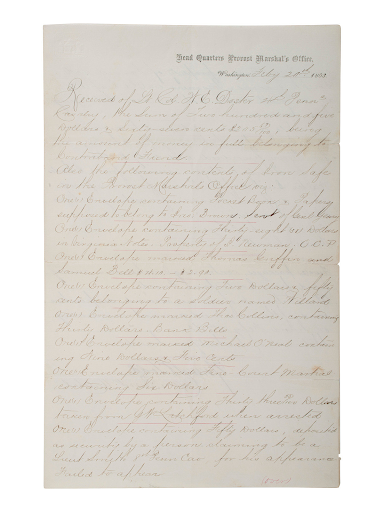
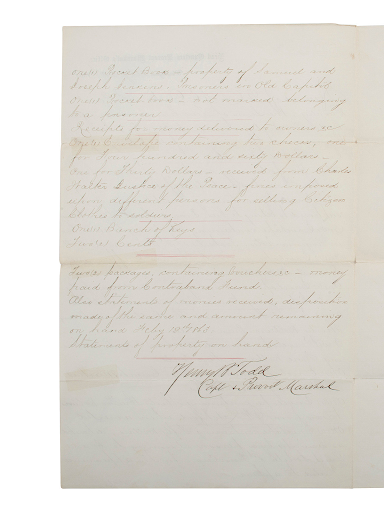
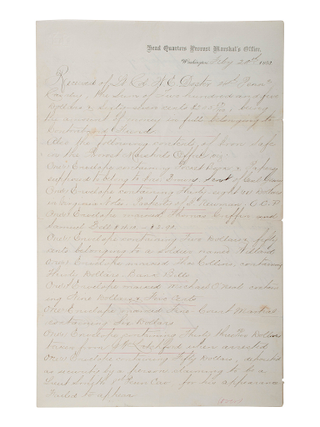
[Slavery and Emancipation][Civil War] Autographed document regarding the Contraband Fund, 20 February 1863, constitutes material evidence of the Union Army’s fiscal administration of aid to self-emancipated African Americans during the Civil War. Created in Washington, DC at a moment when federal emancipation policy was shifting from military necessity to structured oversight, the manuscript records the transfer of funds designated for the support of formerly enslaved people who had fled to Union lines. The Contraband Fund functioned as a precursor mechanism to the Freedmen’s Bureau, established in 1865, and reflects the Union government’s developing infrastructure for managing refugee relief, labor organization, and Black military recruitment in the wake of the Emancipation Proclamation.Todd, Henry B. Autographed document regarding the Contraband Fund. Washington, DC: Head Quarters Provost Marshal’s Office, 20 February 1863. Two pages, folio. Signed by Henry B. Todd. The document records in part: “Received of Lt. Col. H.C. Doster 21st Penna Cavalry, the Sum of Two hundred and five Dollars & Sixty-seven cents $205.67/100, being the amount of money in full belonging to [the] Contraband Fund.” Written on printed Head Quarters Provost Marshal’s Office letterhead, the receipt formalizes the transfer of $205.67 from Lieutenant Colonel H. C. Doster of the 21st Pennsylvania Cavalry, demonstrating the regulated handling of funds within Union military channels.
Issued less than two months after the Emancipation Proclamation took effect and during the initial phase of Black enlistment into what would become the United States Colored Troops, this document situates financial accountability alongside military transformation. Contraband camps, often established under army supervision, became sites of shelter, education, wage labor experimentation, and recruitment; thousands of men from such camps enlisted in 1863. The Provost Marshal’s involvement underscores how emancipation required administrative structure as much as proclamation. Old fold separations neatly reinforced on verso, minor toning consistent with age. Very good condition. A contemporaneous manuscript record illustrating the Union Army’s bureaucratic management of Black freedom at a formative stage of federal Reconstruction policy.
Item #18608
Price: $2,200.00
See all items in Slavery & Abolition, Civil War, Washington D.C., Civil War
See all items in African American History, American History & Americana, American History by State, Military & War, Autographs, Manuscripts & Letters
See all items by Self-Emancipation Freedmen
See all items in Washington D.C.;Pennsylvania
Suggested Slavery & AbolitionBrowse All





Suggested Civil WarBrowse All



Suggested Washington D.C.Browse All






Suggested African American HistoryBrowse All