Women’s Suffrage and Progressive Reform, Jane Addams Wants to Vote Handbill on Municipal Housekeeping, 1911
Pamphlet
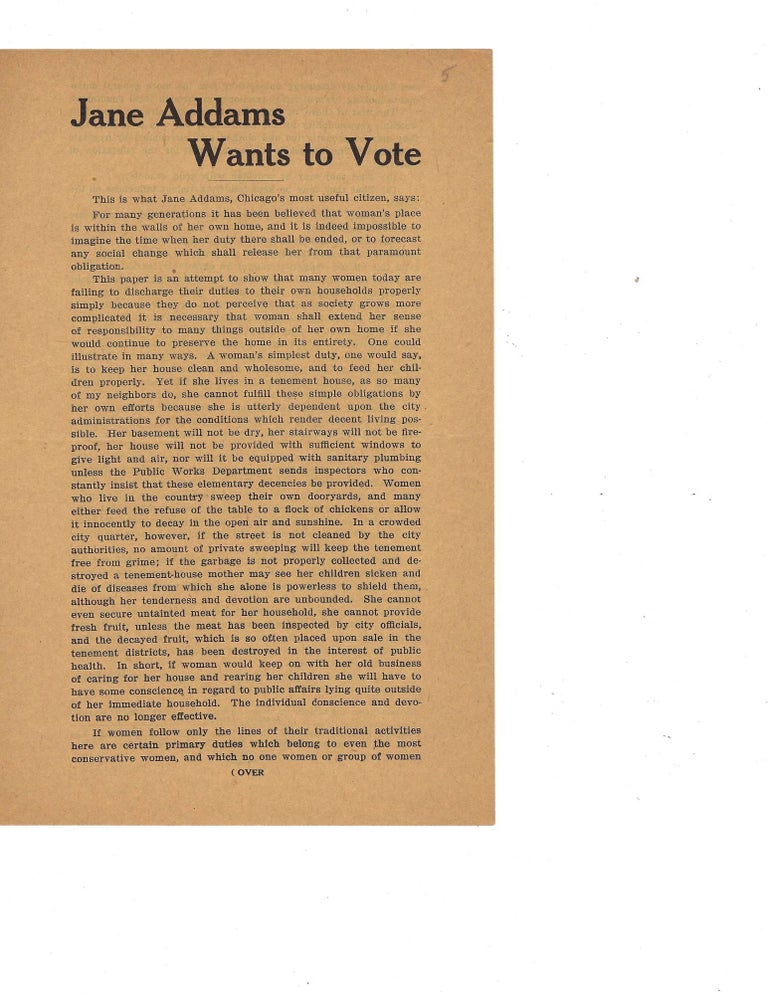
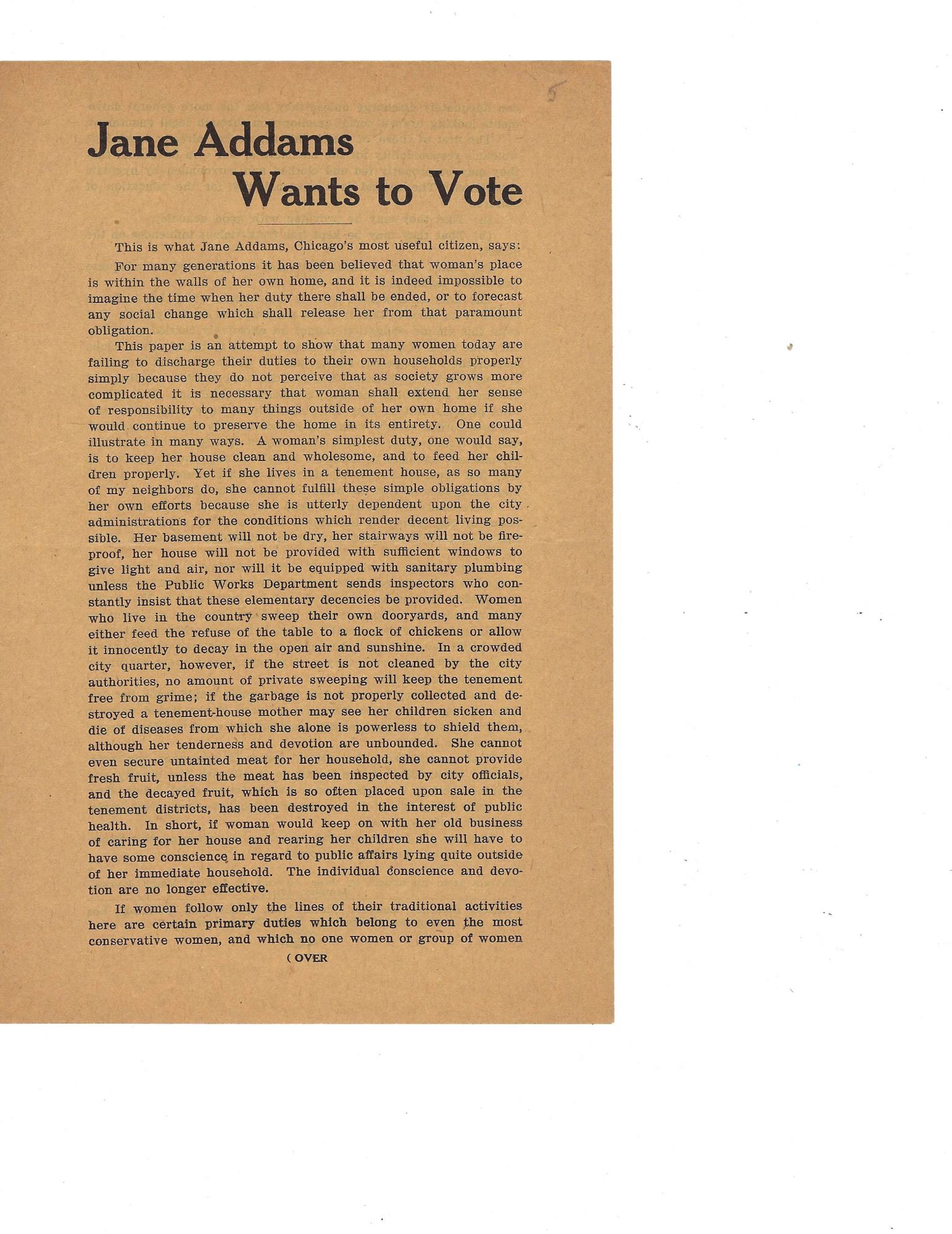
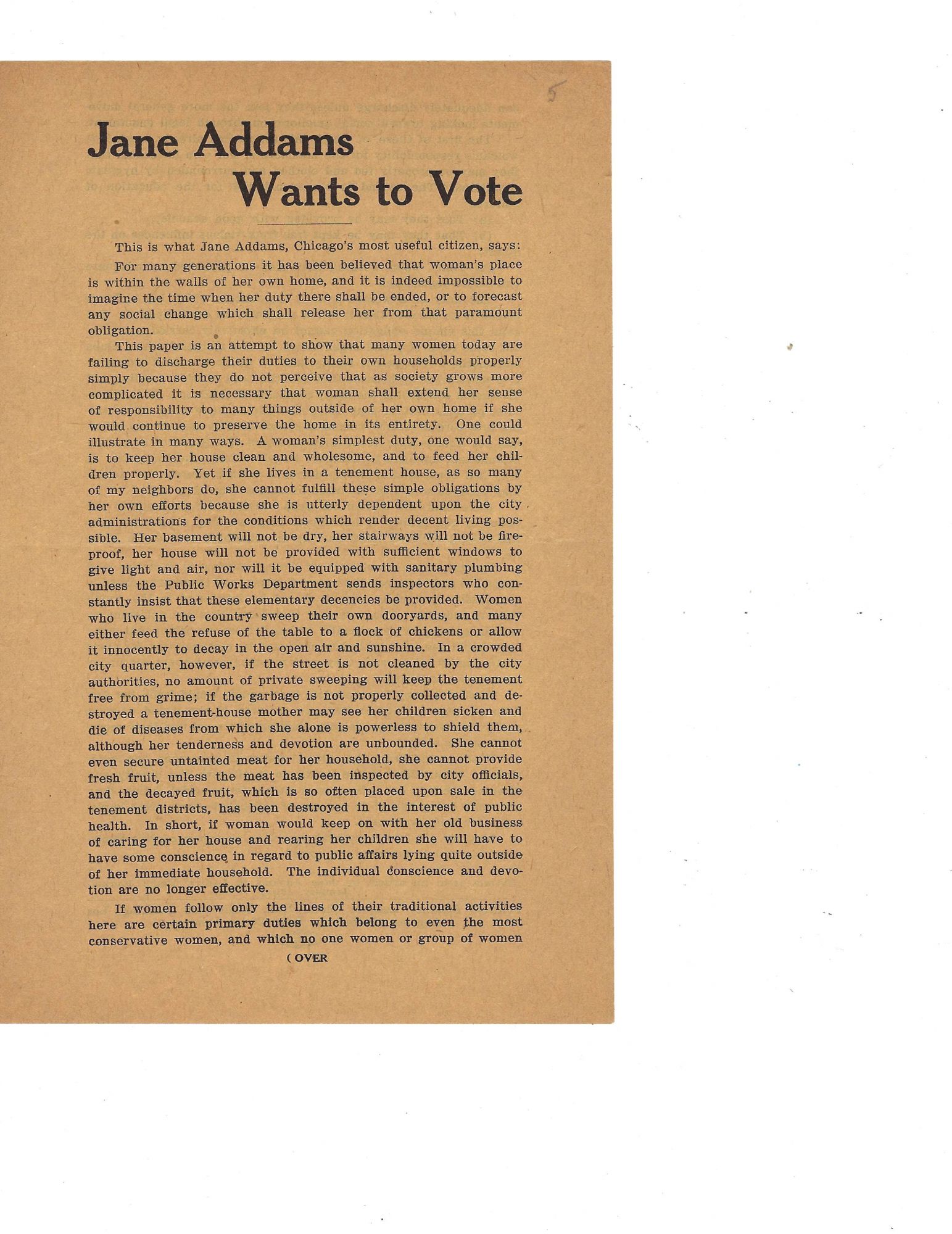
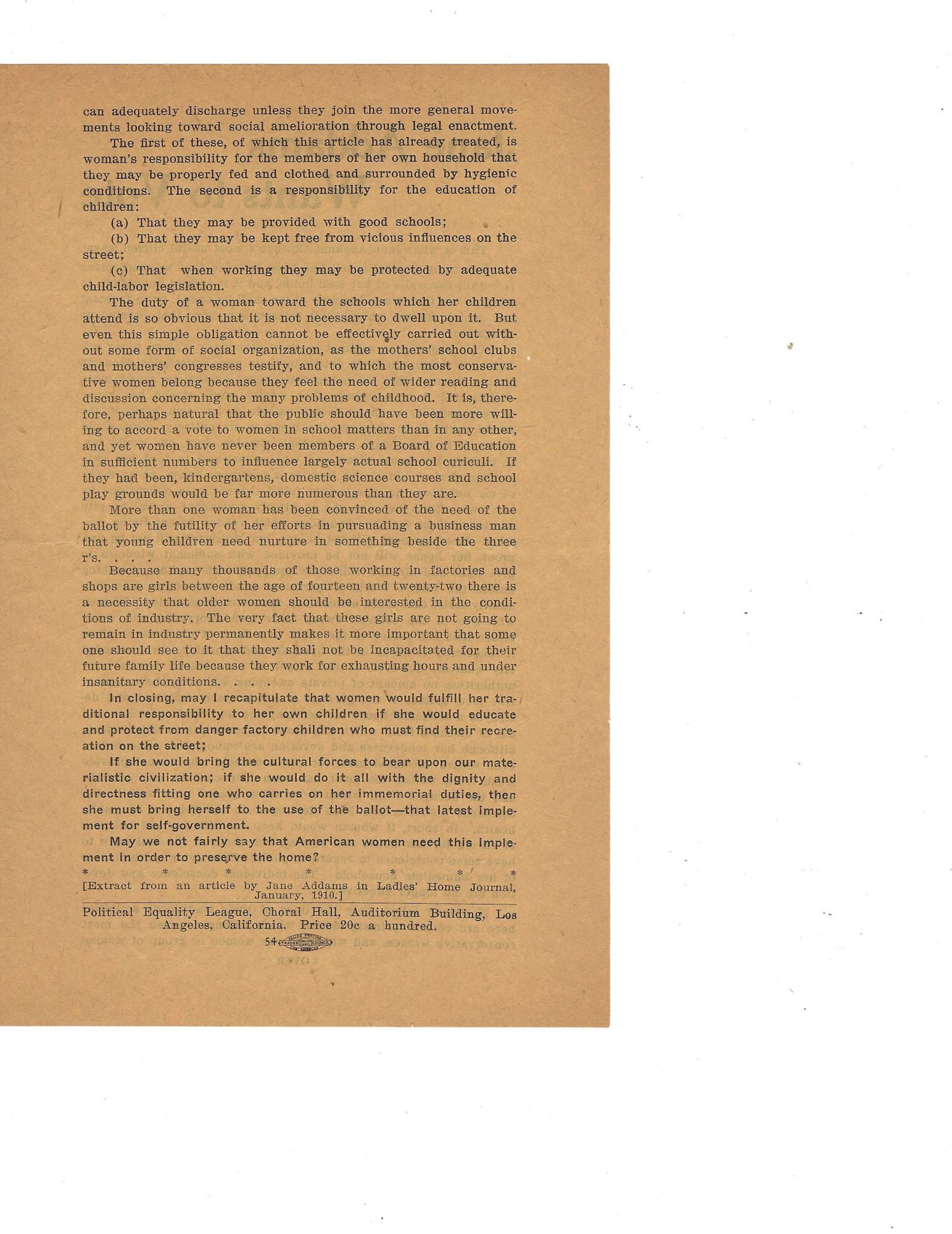
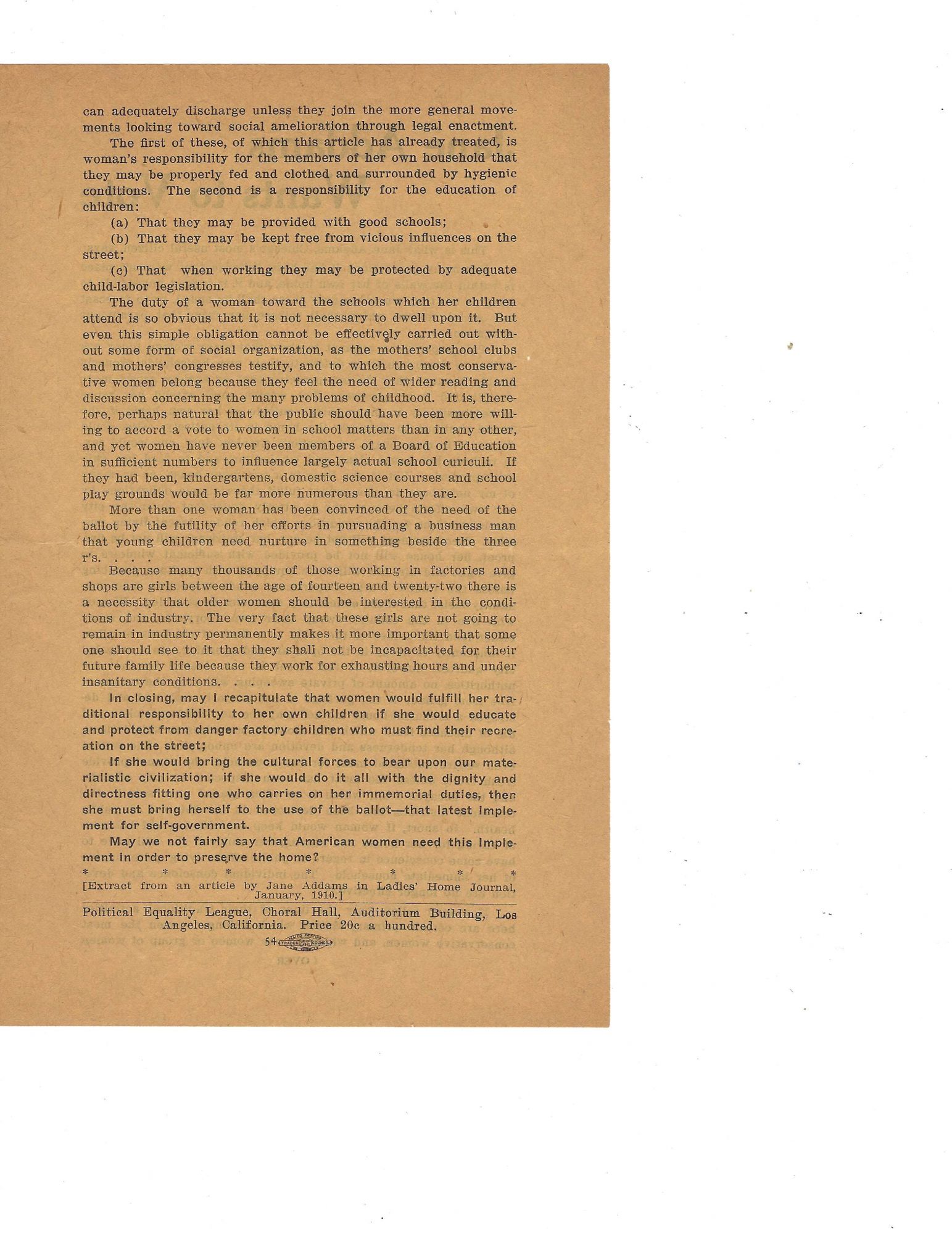
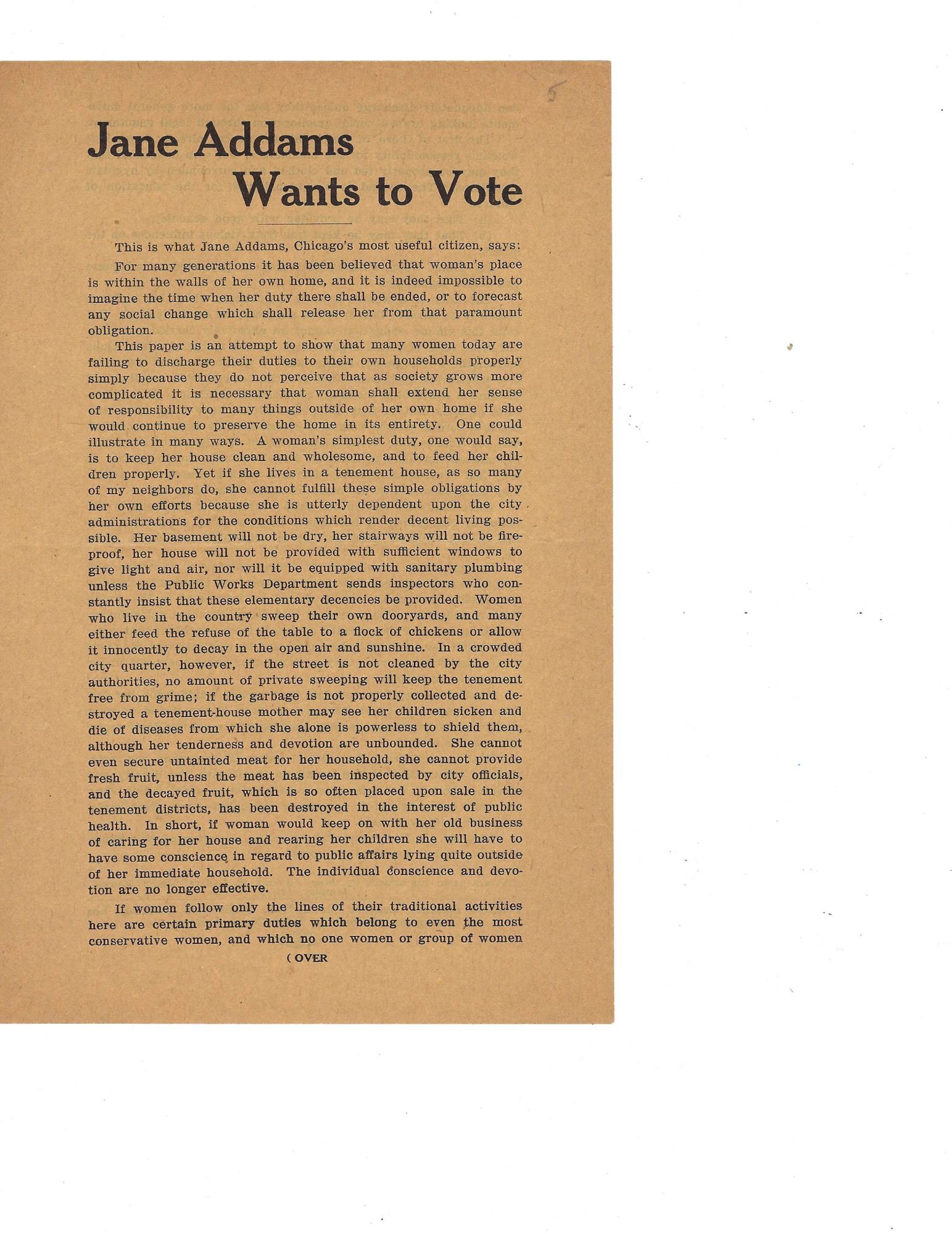
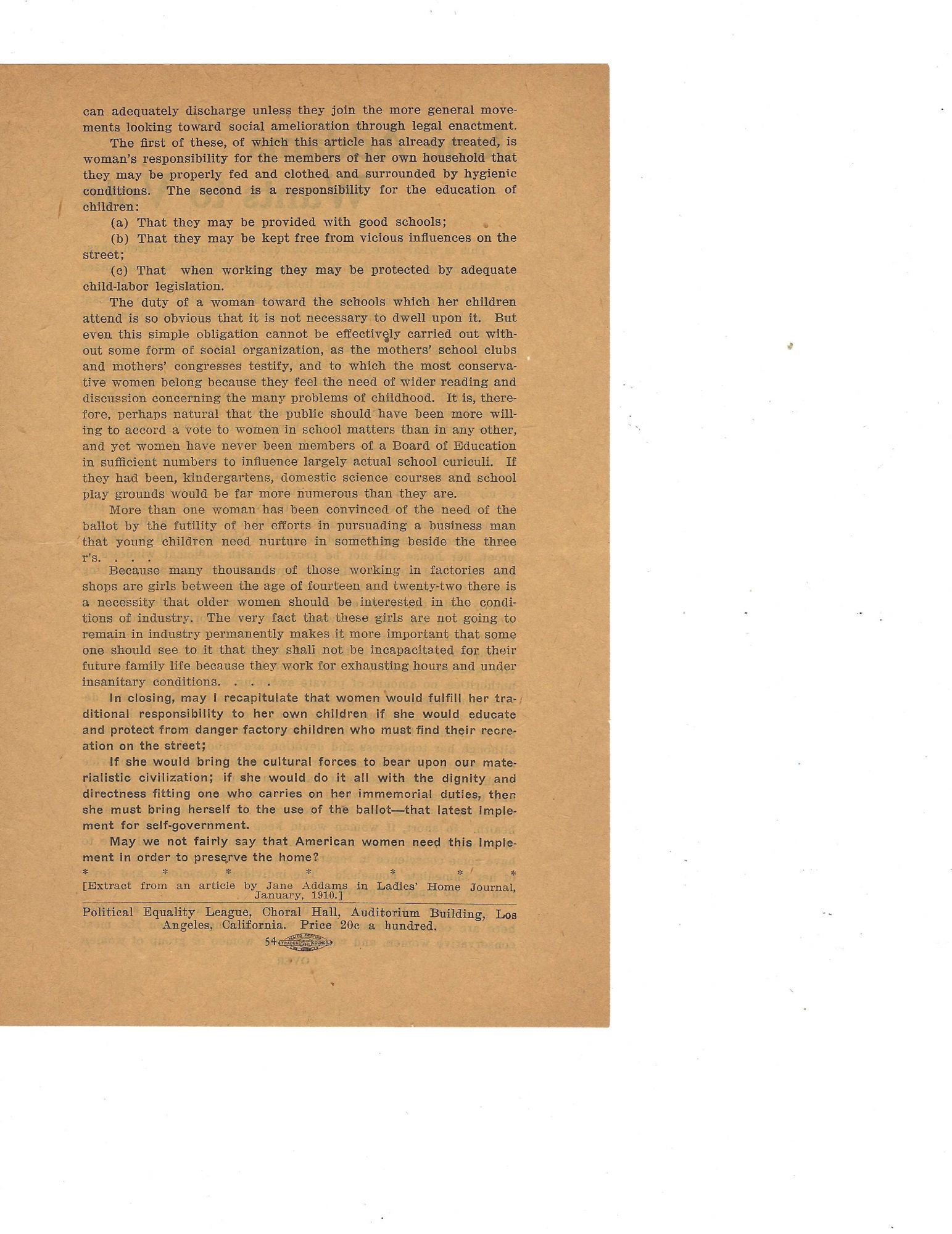
Addams, Jane, Jane Addams Wants to Vote, 1911, documents Progressive Era suffrage advocacy through the argument that women needed political power to influence municipal systems governing food safety, sanitation, housing, fire protection, and public health. The handbill presents women’s suffrage as a mechanism of civic reform, revealing how Addams connected the household to city administration and demonstrating the process by which suffragists translated domestic responsibility into a claim for the ballot. Extracted from Addams’s 1910 Ladies’ Home Journal article “Why Women Should Vote,” the text provides primary-source evidence for the study of women’s suffrage, settlement-house reform, urban governance, and the “municipal housekeeping” argument central to Progressive women’s political activism. The Jane Addams Papers identify the original article as published in Ladies’ Home Journal in January 1910 and summarize its argument as the claim that women required the vote because feeding and protecting children in the modern city were no longer fully within private household control.Jane Addams Wants to Vote. Jane Addams. Publisher city and publisher not supplied, 1911. Handbill. Size not supplied. The text excerpts Addams’s suffrage argument that women needed the vote to secure conditions under which “the members of her own household” could be “properly fed and clothed and surrounded by hygienic conditions.” Addams’s reasoning moves through specific urban services: women in cities are described as “utterly dependent upon the city administrations for the conditions which render decent living possible,” including sanitary plumbing in tenement bathrooms, fireproof stairways, inspected meat, and regular garbage removal. The handbill’s force lies in its practical civic logic rather than abstract rights language alone, showing the mechanisms of municipal dependency through examples of housing, markets, streets, and public-health regulation.
Issued in 1911, the handbill belongs to the period when national suffrage organizations increasingly framed women’s voting rights as necessary to public welfare, child protection, labor reform, and urban accountability. Addams’s prominence as the founder of Hull House and a nationally recognized reformer made her especially effective in linking suffrage to settlement-house concerns and to the everyday administrative systems that shaped immigrant, working-class, and tenement life. Public search results locate a dealer record for this handbill, while institutional holdings were not independently confirmed here; any scarcity claim should therefore be stated cautiously and checked against current OCLC or institutional catalogues before publication. Pencil notation “5” at upper right corner, not affecting text; otherwise near fine. A focused Progressive Era suffrage handbill showing how Addams made the ballot a tool for municipal reform, household protection, and women’s civic authority.
Item #16031
Price: $480.00
See all items in Prison & Prison Reform, Social Activism, Women’s Liberation & Feminism, Women’s Suffrage & Early Women’s Rights
See all items in Law, Incarceration & Public Policy, Social Activism & Protest, Women’s History & Feminism
See all items by Jane Addams
Suggested Social ActivismBrowse All