
Gerald R. Ford Pardon of Richard Nixon September 8, 1974 Constitutional Resolution of Watergate Crisis
Manuscript & Autographs
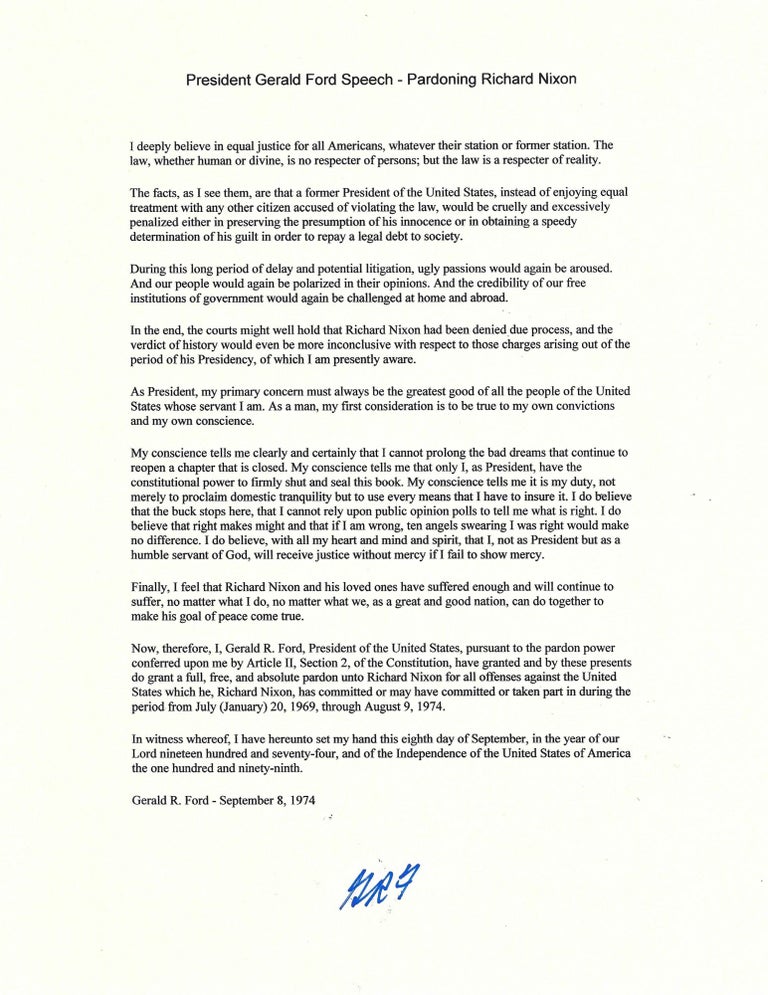
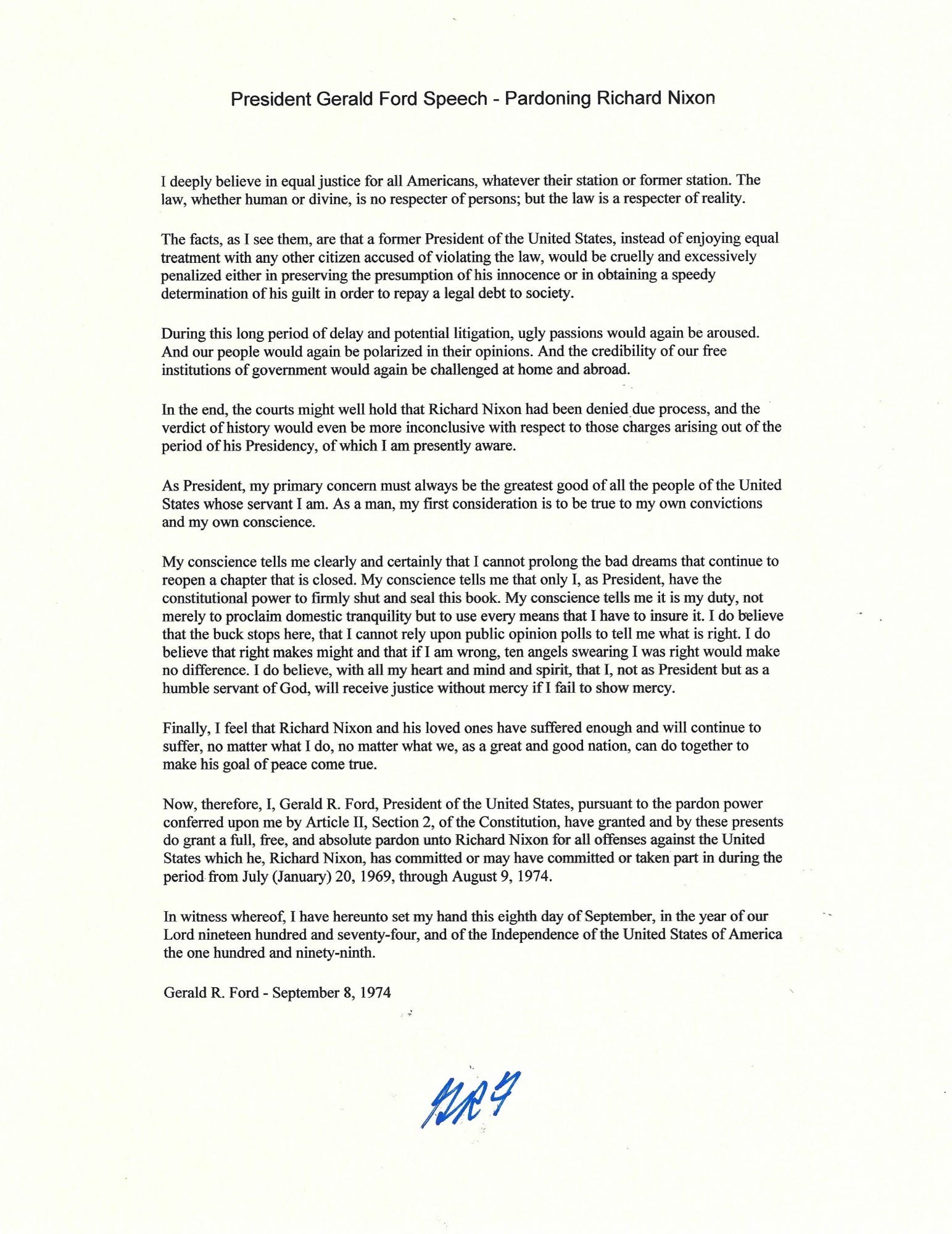
Ford, Gerald R. “President Gerald Ford Speech Pardoning Richard Nixon,” September 8, 1974, issued one month after the resignation of Richard Nixon, constitutes the formal executive action that terminated federal criminal exposure arising from the Watergate scandal and redefined the limits of presidential accountability. Delivered during the immediate post-resignation crisis, the proclamation invokes Article II, Section 2 of the U.S. Constitution to grant “a full, free, and absolute pardon,” asserting the continuity of executive authority at a moment of institutional instability. The document directly articulates Ford’s justification for clemency in language emphasizing national recovery over prosecution, including the statements: “I deeply believe in equal justice for all Americans… the law is a respecter of reality,” and “my primary concern must always be the greatest good of all the people of the United States.” It concludes with the decisive constitutional act: “Now, therefore, I, Gerald R. Ford… have granted… a full, free, and absolute pardon unto Richard Nixon for all offenses against the United States,” followed by the date September 8, 1974.Single-page souvenir copy of the pardon speech headed “President Gerald Ford Speech Pardoning Richard Nixon,” bearing a blue-ink signature “G. R. F.” The text reproduces Ford’s official proclamation language, including his assertion that “my conscience tells me… I cannot prolong the bad dreams… only I, as President, have the constitutional power to firmly shut and seal this book,” framing the pardon as an act intended to conclude national political crisis. The document presents the full formal declaration of clemency alongside Ford’s explanatory rhetoric, preserving both the legal mechanism and its contemporaneous justification.
Issued at the close of the Watergate investigations and immediately following Nixon’s departure from office, the pardon marked a decisive intervention in the relationship between executive power and criminal liability, shaping subsequent debates over presidential immunity, accountability, and the scope of constitutional pardon authority. The language of the proclamation, grounded in both legal authority and moral reasoning, has remained central to historical and legal scholarship on executive clemency and crisis governance in the United States. Light handling wear; clean and legible throughout; signature clear. Overall very good condition.
Item #4528
Price: $550.00
See all items in U.S. Presidents & Politicians, Law & Public Policy
See all items in American History & Americana, Law, Incarceration & Public Policy, Autographs, Manuscripts & Letters
See all items by Gerald Ford