CIO Anti-Racial Discrimination Organizing and the Battle for Wartime Civil Rights , Archive 1943-51
Pamphlet
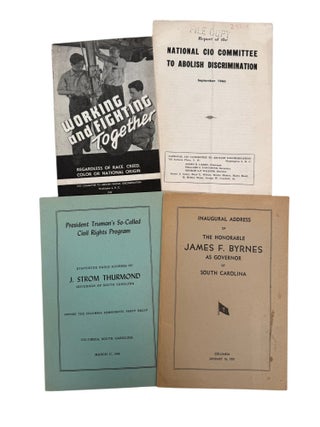
Anti-discrimination and civil rights pamphlet archive from 1943 to 1951, documenting competing responses to racial discrimination as wartime labor mobilization gave way to the postwar struggle over federal civil rights legislation and Southern resistance. The group begins with the CIO Committee to Abolish Racial Discrimination’s Working and Fighting Together, issued during World War II to argue that organized labor depended upon equality “regardless of race, creed, color or national origin,” and proceeds through a 1945 report by the same committee, President Harry Truman’s 1948 civil rights program, and the 1951 inaugural address of South Carolina governor James F. Byrnes. The sequence records a political conflict that moved across unions, the presidency, Congress, and Southern state government: the CIO sought to make racial equality a principle of industrial unionism; Truman proposed federal action against lynching, poll taxes, employment discrimination, and segregation; Southern Democrats responded by defending state authority and segregation; and Byrnes entered the South Carolina governorship in 1951 as the state faced mounting federal challenges to its racial order.Archive of four printed documents, Washington, D.C., South Carolina, 1943–1951.
[1] Working and Fighting Together: Regardless of Race, Creed, Color or National Origin. Washington, D.C.: CIO Committee to Abolish Racial Discrimination, 1943. 20 pages. Illustrated staple bound wrappers. Produced during wartime industrial mobilization, the pamphlet presented racial discrimination as a labor question and argued for union organization across racial and ethnic divisions. The CIO had established its Committee to Abolish Racial Discrimination with James B. Carey as chairman, Willard S. Townsend as secretary, and George L. P. Weaver as director, placing anti-discrimination work within the institutional structure of the federation.
[2] Report of the National CIO Committee to Abolish Discrimination. Washington, D.C.: National CIO Committee to Abolish Racial Discrimination, September 1945. 33 pages. Staple bound wrappers. The report opens immediately after World War II with the declaration that “The war, which seemed to be of interminable duration, has ended,” and argues that wartime promises of democracy had created new expectations for Black Americans in employment, housing, education, and public life. Its foreword describes organized labor as “the most powerful force in the struggle for democracy” and defines the CIO’s task as bringing “the working men and women of America, regardless of race, creed, color or nationality” into labor unions for mutual protection. The rear wrapper identifies the committee’s officers as James B. Carey, chairman; Willard S. Townsend, secretary; George L. P. Weaver, director; and members including James J. Leary, Boyd L. Wilson, Morris Muster, Harry Read, M. Hedley Stone, and George W. Crockett, Jr.
[3] Thurmond, J. Strom. President Truman’s So Called Civil Rights Program. Statewide Radio Address of J. Strom Thurmond, Governor of South Carolina, Before the Columbia Democratic Party Rally. Columbia, South Carolina, March 17, 1948.12 pages. Printed green staple bound wrappers. Issued during the confrontation between Truman and segregationist Southern Democrats that culminated in Thurmond’s States’ Rights Democratic presidential candidacy later that year, the pamphlet preserves the South Carolina governor’s response to the administration’s federal civil rights proposals and belongs to the immediate political setting of the Dixiecrat revolt.
[4] Byrnes, James F. Inaugural Address of the Honorable James F. Byrnes as Governor of South Carolina. Columbia, South Carolina, January 16, 1951. 9 pages. Printed tan staple bound wrappers with South Carolina palmetto emblem. Byrnes, formerly a United States senator, Supreme Court justice, wartime director of economic mobilization, and Secretary of State, returned to South Carolina politics as the state confronted legal challenges to segregation. The address recommends ratification of a constitutional amendment repealing the poll tax requirement and declares that “a law enforcement organization has been made to effect the purposes of our Reorganization Act,” while calling for criminal statistics and stronger enforcement against lawbreaking. His governorship coincided with South Carolina’s effort to preserve segregated public education through a program of equalizing Black and white school facilities as challenges to segregation moved through the federal courts.
The four pamphlets in this archive trace the fragmentation of the Democratic political order over race during and immediately after World War II. The CIO’s wartime Committee to Abolish Racial Discrimination linked union strength to interracial organization and treated discrimination in employment as incompatible with industrial unionism; its 1945 report carried that position into reconversion, when Black workers faced renewed pressure over jobs gained during wartime labor shortages. Truman subsequently moved civil rights into presidential politics, calling for federal protection against lynching, abolition of the poll tax, a permanent Fair Employment Practice Commission, and other measures that challenged the political structure of the segregated South. Thurmond’s March 1948 address appeared during the Southern Democratic revolt against that program, only months before he became the presidential candidate of the States’ Rights Democratic Party. Byrnes’s 1951 address records the next phase in South Carolina, where state officials attempted to preserve segregation while responding to federal litigation over unequal schools. The chronology therefore moves from an interracial labor organization defining discrimination as an obstacle to worker solidarity, through federal civil rights proposals and an organized segregationist political reaction, to state government confronting the legal instability of Jim Crow at the opening of the 1950s. Moderate toning, edge wear, occasional creasing and handling marks; the 1945 CIO report bears an institutional ink stamp and manuscript notation to the front wrapper. Overall good condition. A compact documentary sequence of the political struggle over racial equality from wartime CIO organizing through the 1948 civil rights rupture in the Democratic Party and the defense of segregation in early 1950s South Carolina.
Item #23805
Price: $1,550.00
See all items in African American Labor & Employment, Civil Rights Movement, South Carolina, Civil Rights Movement, World War II, Social Activism
See all items in African American History, American History by State, Civil Rights, Military & War, Social Activism & Protest
See all items by CIO Committee to Abolish Racial Discrimination
See all items in South Carolina, Washington D.C.
Suggested Civil Rights MovementBrowse All



Suggested Social ActivismBrowse All


Suggested World War IIBrowse All





Suggested South CarolinaBrowse All